
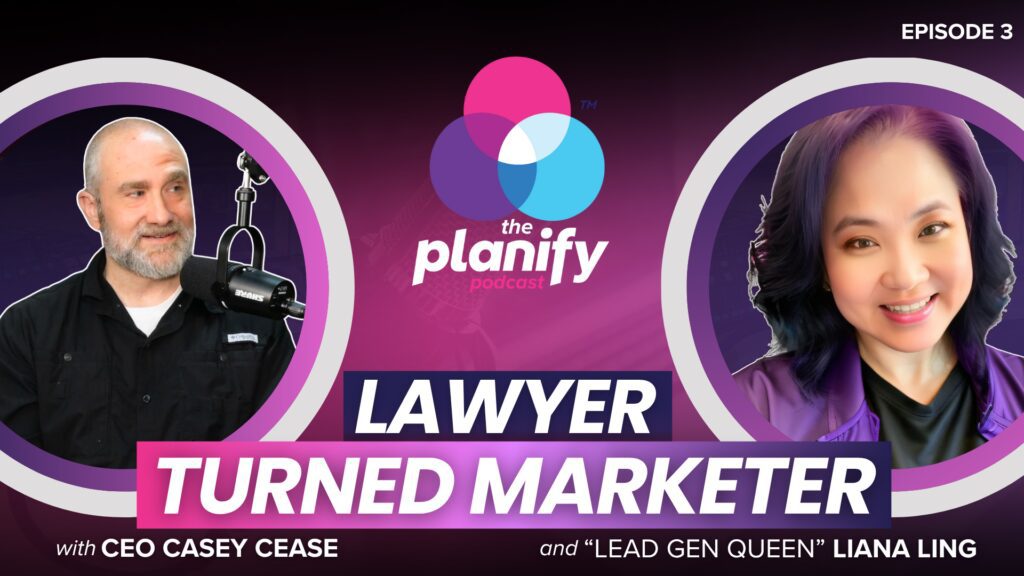
Marketing in 2026 is not for the faint of heart. Meta’s algorithms have shifted dramatically since the disruptions of 2024 and 2025, and AI integration is changing the landscape every single day. When what worked six months ago suddenly stops working, most business owners panic.
But Liana Ling isn’t most business owners.
Known across the industry as the “Lead Gen Queen,” Liana is an attorney turned marketing and brand strategist. Originally from Canada, she spent nine years as a litigation lawyer before a restructuring forced her to realize she was actually a frustrated entrepreneur locked inside a lawyer’s life.
Today, she helps B2B businesses scale and fill their pipelines. She also possesses a unique superpower: the ability to view massive problems as simple testing opportunities. Whether she is navigating a broken ad funnel, adapting to AI, or even battling cancer, her framework remains the same.
On this episode of the Planify Podcast, host Casey Cease sat down with Liana to deconstruct exactly how she tests her way out of failure and how you can apply her framework to your own business.
Watch/Listen
Listen on Your Favorite Platform
The Muscle of Failure: Treating Business Like a Science Lab
Most entrepreneurs are terrified of failure. Liana Ling actively runs toward it.
The seed for this mindset was planted when Liana worked with Lewis Schiff and Norm Brodsky at the Inc. Business Owners Council and Birthing of Giants. Working behind the scenes of Schiff’s book, Business Brilliant, Liana learned a foundational principle: self-made, successful people embrace failure, love it, and leverage it as a stepping stone.
Failure is a muscle that must be intentionally built. It still hurts, but as a marketer, it happens constantly. You will put an idea up on ads, and most of the time, it won’t work.
Instead of getting emotional, Liana treats the world like a testing lab. She even keeps a testing log—much like a 7th-grade science project—documenting her hypotheses and notes to methodically test her way out of any problem.
Detaching Emotion from the Outcome
One of the most vital lessons Liana has learned is the necessity of detaching emotion from funnels, products, and ads. When a campaign fails, it is easy to take it personally. But by removing the emotion, you can look at the raw data.
Liana admits that often, when she thinks a specific creative or ad is horrible and won’t work, she is completely wrong. The market dictates what works, not your personal feelings.
This objective, relentless testing approach transcends business. When Liana was diagnosed with Type 2 diabetes, she applied this exact framework to her body and was off insulin in just two weeks. It is also the exact same resilient mentality that helped her navigate and survive cancer treatments.
The “Micro-Yes” Method to Fixing Broken Funnels
When launching a new campaign, the biggest mistake marketers make is trying to optimize for the final sale right out of the gate.
Recently, Liana launched an assessment funnel designed to help users identify their “lighthouse authority”. Instead of praying for instant leads, she utilized Flint McLaughlin’s “Micro-Yes” method, breaking the user journey down into tiny, sequential steps.
Here is how you systematically test a funnel:
- Step 1: Stop the Scroll. The very first goal is simply getting a user to stop and look at the ad. If you cannot achieve this, nothing else matters. Liana runs multiple creatives just to see what stops the right person.
- Step 2: The Click-Through. Are they reading the ad and taking action?. For the first three days of her lighthouse assessment, nobody was clicking until she changed the creatives.
- Step 3: The Opt-In. Once they click, are they filling out their information?. Liana noticed a bottleneck here. She consulted a business partner, changed the headline offer, and a lead came in immediately.
- Step 4: Continuous Refinement. Once the micro-yeses align, you continue testing the results pages, follow-up automations, and lead quality.
You must keep feeding your system fresh data. If you break everything down into micro-steps, diagnosing and fixing a failing ad campaign becomes simple math rather than a mystery.
How to Work with AI: The “Microemployee” Framework
We are currently navigating a massive shift where businesses are trying to figure out how AI fits into their workflows. Some people are terrified to even get started.
Liana and Casey have been leveraging AI since before ChatGPT was mainstream. Liana views AI the same way she views a calculator or a Google search—it is a natural tool to augment human thought and decision-making.
However, her mental model for interacting with AI is completely unique.
A mentor, Zach Hammer, once told Liana: “AI is not your friend, it’s your enemy”. He challenged her to think about how she would work with an enemy she didn’t trust in order to squeeze the absolute most value out of them.
This mindset shift changes everything. Instead of blindly trusting AI to run her business, Liana treats her AI tools as “microemployees” with highly niched tasks.
- AI as an Idea Generator: Liana uses AI like an intern. The AI might pitch terrible ideas, but simply forcing Liana to think about a concept from a new angle is incredibly valuable.
- The Creative Director Model: Liana acts as the Creative Director, letting AI do the heavy lifting of drafting copy or generating ideas, while she provides the forceful direction.
- The “Contrarian” Agent: Casey built a “Board of Advisors” on his open claw VPS instance. One of the most helpful AI agents he created is the “Contrarian,” whose sole job is to poke holes in his ideas and force him to find clarity before he takes the idea to his actual human advisors.
- Better Human Conversations: Liana uses AI to translate complex concepts (like a mentor’s book or a media buyer’s data) so she can ask much deeper, more intelligent questions when she finally talks to the human expert.
The goal is not to figure out how to avoid being replaced by AI. The goal is to identify the human parts of your role and use AI to augment them.
Authentic Personal Branding in an Era of “AI Slop”
In 2026, anyone can ask an AI tool how to spam the internet with 500 pieces of automated content every single day. People are already pushing out what the industry calls “AI slop”.
Because of this, authentic personal brands are becoming significantly more valuable. Consumers—especially younger generations—are highly skeptical of AI and crave real, human authenticity.
So, how do you stand out?
1. Leverage the “Greatest Hits”
Digital marketing pioneer Dennis Yu frequently reminds marketers that they are not news agencies. You do not need to constantly churn out new content to fill a calendar. Instead, find your “greatest hits”—the content that has already proven to work—and leverage it. Use AI to help sift through your data to identify those hits, and then put ad spend behind them.
2. Collaborate with Other “Lighthouses”
Authority is passed through association. By collaborating with other experts in your space—like Liana and Casey recording a podcast together—you naturally pass credibility to each other across your respective audiences.
3. Stop Hiding Behind High-Production Value
You do not need a fancy studio to be effective. Liana notes a creator in her community who goes live for artists using nothing but a plain white background and an iPad. She shows up authentically, shares real examples, and gets massive results because the audience trusts that she is a real person actually doing the work.
Stop hiding behind AI. The world wants to see you.
Where to Find Liana Ling
Want to dive deeper into testing methodologies, lead generation, and business strategy? You can find Liana Ling (The Lead Gen Queen) online at powerupstrategy.com and across all major social media platforms.