
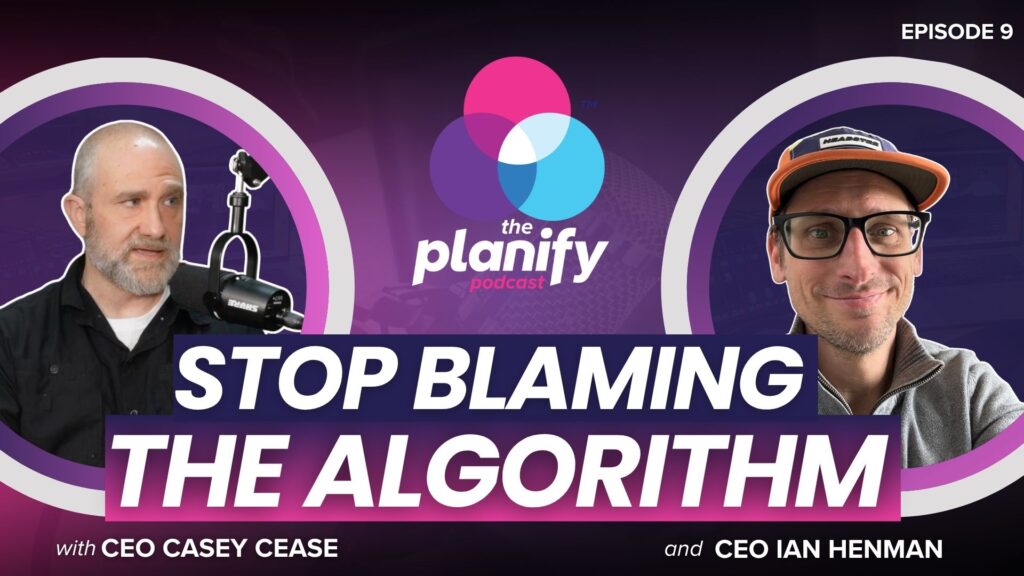
If you feel like advertising is getting harder but AI makes it easier to produce more content, you are not imagining the tension. In this episode of the Planify Podcast, Ian Henman shares what has stayed constant in direct response marketing across more than 20 years, and what has changed as platforms, costs, and consumer trust evolve. The diagnosis is simple: many businesses chase clicks, automate messy messaging, and then wonder why leads decline or quality feels worse.
This episode is essential for business owners, marketers, and copywriters who want to use AI in a grounded, ethical way that improves ad performance without overselling or breaking continuity between the promise and the deliverable. You will learn (1) what buyer psychology should anchor your ads, (2) where broad targeting quietly kills results, (3) how an AI workflow can scale creative production through repeatable SOPs, and (4) what “ethical persuasion” looks like when automation is involved.
Listen on Your Favorite Platform
Why this is happening
- Trust is decreasing while ad costs keep rising.
Ian describes a widening gap: CPMs (cost per thousand impressions) and acquisition costs are climbing, while consumers’ trust is eroding. When advertisers try to compensate, messaging often becomes more exaggerated or fear-based, which can further damage trust and reduce lead quality. - AI amplifies your habits, not your strategy.
Ian’s core warning is that AI can scale whatever you do today. If your creative process depends on vague positioning, rushed hooks, or unclear offers, AI can increase output while also increasing mediocrity. - Attention is fragmented, and “spray and pray” is less effective.
Ian repeatedly comes back to the problem of ubiquity. Even if your offer is solid, if your messaging is not specific enough, people self-select out. In many categories, buyers are not searching for your category right now, so your ad must help them identify why your solution fits them. - Copywriting is still a human skill, even with AI.
Ian’s stance is blunt but useful: AI is not inherently good at writing persuasive ads. It can help with variations, assets, and workflows, but the ad needs a structure, angle, and understanding of why people buy.
Where you are getting stuck
- You are selling too broadly.
A common bottleneck is describing your business in a way that “sounds true” but fails to feel personal. Ian’s roofing example illustrates this. Broad claims like “new roof after hail” are often not enough. Specific qualifying questions and scenarios help your ad reach the right people and self-segment the rest. - You optimize for production, not persuasion.
Many teams treat AI like a creative factory. The result is more assets, not better messaging. If the first five to ten seconds of video does not earn attention, the rest does not matter. - You outsource thinking to the tool.
Ian warns against letting an LLM “run you.” If you respond to outputs without structure, you can create chaos in your workflow and feel busy while performance declines. - You confuse ethical persuasion with “tricking people.”
Some fear AI will feel insincere because it can create fake people, fake visuals, or misleading expectations. Ian’s framing is more precise: the ethical question is not “AI exists” but whether the ad misrepresents reality, breaks continuity with the offer, or makes promises the business cannot fulfill. - You chase leads without protecting lead quality.
If your funnel attracts the wrong prospect, you can end up with high volume and low conversion. Ian connects this to the trust gap and to emotionally triggered decision-making when offers feel too good to be true.
A practical framework: AI advertising as a repeatable process, not a random tool
Below is a simple framework drawn from the episode’s themes and workflow progression: anchor in buyer psychology, narrow your offer, then use AI to systematize production.
Step 1: Start with buyer psychology and the “why now” problem
Before tools or platforms, define:
- Who the buyer is (demographic basics are a starting point, not the finish line).
- What problem they are actively trying to solve.
- Where they hang out (platform and placement thinking should follow audience understanding).
- Why your offer matches the moment (the “why now” component that reduces skepticism).
Ian emphasizes that you cannot rely on a tool to invent a persuasive angle. Even with automation, you still need the human work of research and positioning.
Step 2: Make your offer specific enough for self-selection
If your ad is broad, your audience becomes broad, and performance suffers.
Use this test:
- Can your ad name the scenario that fits the right buyer?
- Does it include qualifying details that reduce tire-kickers?
- Would someone who is not the ideal prospect reasonably think, “This is not for me”?
In the episode, Ian’s point is that the ad should guide the buyer through a logical chain of concern. Each detail should lead to the next.
Step 3: Treat ad production as “SOPs + APIs” so you can iterate quickly
Ian’s AI progression follows a practical maturity model:
- Use AI for creative attention mechanics (especially video intros and visuals for the first moments).
- Move from tool mastery to workflow mastery (what is running the tool, what inputs it needs, and how to automate the steps).
- Shift to API-driven production when you need scale (so you are not manually prompting everything).
The key insight: AI helps most when you convert your workflow into something repeatable:
- Voice creation
- Visual ideation
- B-roll generation
- Editing and assembly into final ad variations
- Asset reuse for future iterations
Step 4: Use quality placements to reduce “trust leakage”
Ian predicts better ad performance can come from placements that feel more captive, where the viewer is not multitasking as aggressively. He describes testing living-room TV style placements with YouTube-linked targeting, and argues that larger-screen contexts can force higher creative standards.
Even if you do not adopt the same placement, the principle applies:
- Choose placements that match how your audience consumes media.
- Ensure your ad visuals look legit enough that trust is not disrupted before the message lands.
Implementation tips and examples (actionable mini-scenarios)
Mini-scenario A: Improve your hook without rewriting everything
If you already have a strong script but performance is inconsistent:
- Create 10 to 20 alternate visuals or motion treatments for the opening segment.
- Keep the first five to ten seconds tightly aligned with the hook message.
- Test variations based on attention cues rather than adding more claims.
Ian’s point is not that the entire ad is irrelevant. It is that you lose viewers before they hear your offer if the intro does not earn attention.
Mini-scenario B: Stop selling “roofing” and sell a qualifying situation
Instead of “we fix roofs,” tighten the ad:
- Identify a buyer scenario (for example, roof age and whether storms have happened).
- Add one or two “unseen damage” cues that match how buyers notice problems.
- Use the ad’s language to filter out people who do not match the scenario.
Mini-scenario C: Build a custom B-roll system so you do not burn hours
This reduces wasted spend and improves conversion because your offer becomes easier to believe.
Consider the following workflow:
- A voiceover is created with AI.
- Timestamps are used to map where B-roll needs to appear.
- Custom visuals are generated based on shot lists.
- Automation produces dozens of usable variations quickly.
You do not need to copy Ian’s exact stack to adopt the method. The principle is: generate custom media tied to your script structure so you are not trapped in stale stock footage.
Mini-scenario D: Use AI, but keep humans in control of ethics and continuity
A simple operational rule:
- Make sure every claim in the ad is supportable by the actual offer and fulfillment.
- Avoid “fake reality” that would confuse a buyer about what they receive.
- If you use AI-generated visuals or voices, ensure they still represent the product truthfully.
This addresses the “insincerity” concern without banning AI altogether.
Common mistakes and how to avoid them
- Mistake: Producing many ads but not improving persuasion.
Fix: Track whether the hook earns attention, then whether the message is specific enough for self-selection, then whether trust holds through fulfillment. - Mistake: Letting the tool decide the angle.
Fix: Build your angle from buyer psychology and direct research first. Use AI to generate variations and assets, not to invent positioning out of thin air. - Mistake: Broad messaging that everyone can understand but no one feels.
Fix: Narrow the scenario and use qualifying questions so the ideal buyer recognizes themselves. - Mistake: Automating a broken workflow.
Fix: Start by mapping your current workflow. If it is chaotic, AI will not fix it. You need SOPs first and automation second. - Mistake: Fear-based ethics that becomes paralysis.
Fix: Separate “ethical persuasion” from “lying.” Ask whether the ad creates realistic expectations and whether your fulfillment matches what the buyer believes.
Connect with Ian
Ian Henman, Digital Marketer and YouTube Ad Strategist
- Website: https://www.ianhenman.com
- LinkedIn: https://www.linkedin.com/in/ian-henman/
- YouTube: https://youtube.com/@IanHenmanOfficial
- Facebook: https://www.facebook.com/ianhenmandigital/