
If you are a business owner in 2026, you are probably exhausted. You are tired of throwing money at Facebook ads, guessing at SEO, and paying agencies for “clicks” and “impressions” that never turn into revenue.
You’ve probably asked questions like, “Can you fix my website?”, “Can you set me up on Google Local Service Ads?”, or “What about AI search optimization?”.
The problem isn’t the platforms. The problem is that you are buying isolated tactics when you desperately need a documented strategy.
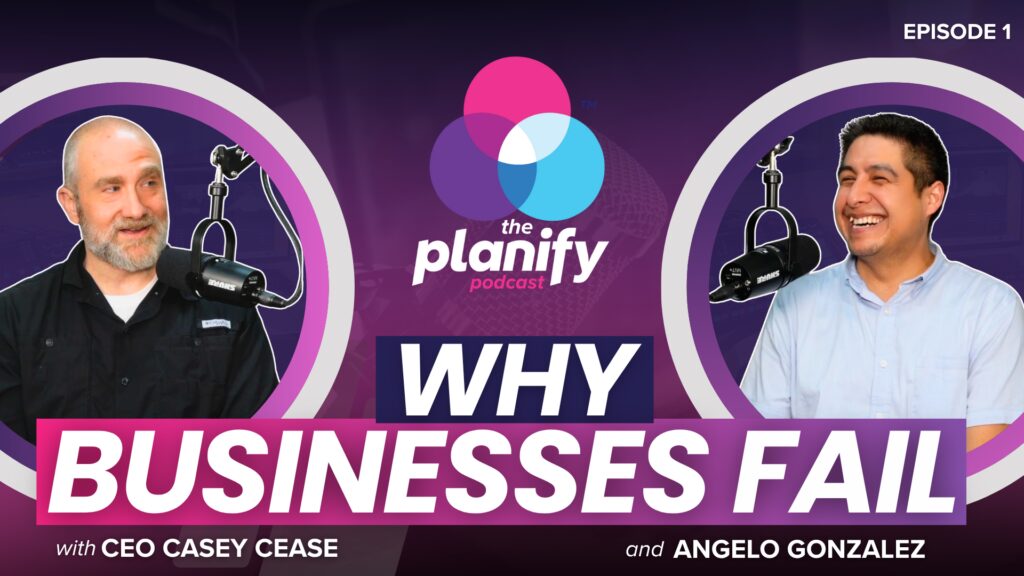
At Planify Agency, our Director of Operations, Angelo Gonzalez , and Owner/CEO, Casey Cease, see this happen every single day. We are a business growth agency. We understand that if you just turn on the traffic without fixing the plumbing, you are going to drown in unqualified leads—or worse, break your operations entirely.
This post is going to break down exactly why random acts of marketing are destroying your ROI, and how to build a foundation that actually scales your business.
Watch/Listen
Listen on Your Favorite Platform
The Genesis of Growth: Pivoting Through Crisis
To understand why strategy matters, you have to understand what happens when a business gets pushed to the brink. Innovation usually doesn’t happen on a beach; it happens during a crisis.
Before Planify Agency existed, Casey Cease owned a highly successful publishing company called Lucid Books. Things were going great. The company was blowing up, printing books on demand, and shipping them out daily. Because of that success, people started asking Casey to help them with their own websites and marketing.
Then, the COVID-19 pandemic hit.
Overnight, the landscape shattered. Amazon abruptly stopped buying books for about 90 days, shifting entirely to medical equipment and household goods. The supply chain froze. Suddenly, with the largest printer and distributor in the world, it took 48 days just to print one single book.
Casey had a choice: bury his head in the sand, or look for an opportunity.
He realized that while physical events and standard operations were shutting down, businesses were desperate to get online—and they needed to do it fast. Casey started giving away his time for free. He offered 30 to 60-minute strategy calls over Facebook to help struggling business owners figure out how to repurpose their operations. He even hosted a “pay-what-you-want” marketing masterclass to help authors who could no longer go on speaking tours.
Through that crisis, Planify Agency was born. It wasn’t birthed from a desire to just “make money.” In fact, Casey openly admits that whenever he has started a business solely for the money, he ended up hating it, even if it was profitable. Planify was built by asking: Who needs help, what am I good at, and how can I provide a solution?.
And the biggest problem they found? Businesses were entirely focused on tactics, but their foundations were broken.
The Trap of the “Tactical Treadmill”
Most marketing agencies operate as turnkey tactical shops. You pay them a retainer, and they turn on the faucet. They run your social media, they manage your Google Ads, and they hand you a monthly report filled with vanity metrics.
But here is the harsh reality: if there are broken elements in the foundation of your business, it doesn’t matter how many leads an ad campaign brings in.
We see business owners get into fights with their marketing agencies all the time. The agency claims, “We are doing our job, look at all these click-throughs and leads!” while the business owner screams, “None of these leads are actually buying anything!”.
This happens because tactics are only meant to be implemented after you have mapped out the customer value journey. If an author comes to an agency wanting to sell a book and says their target audience is “everyone,” they are destined to fail. A book isn’t for both a nine-year-old girl and an 85-year-old man. “Everyone” is not a target audience.
If you don’t know who you are reaching, your ad spend is basically just a donation to Mark Zuckerberg and Google.
Why Flooding Your Business with Leads Can Be Dangerous
Imagine you are a plumber. You hire a tactical agency, and they turn on the lead machine for broken toilets in your geographic area. Suddenly, your phone is ringing off the hook.
Sounds great, right?
Not if your operations can’t handle it. Planify has had clients tell them, “Keep it where it’s at, but please no more leads. We’re capped”.
A standard marketing agency will just set it and forget it. But a true business growth agency will ask the hard questions: Where are you getting stuck? Where are the bottlenecks? Are there AI solutions or operational shifts we can make to scale your capacity?.
Marketing works, sales must be on point, and operations must be fully functional. Only when all three work holistically can a business truly scale.
The 3 Pillars of a Documented Growth Strategy
At Planify, we refuse to execute isolated marketing tactics without a documented strategy. We won’t start until we are aligned on the foundation.
A real, bulletproof growth strategy identifies three core pillars:
Pillar 1: The “Who” (Your Ideal Client Avatar)
Who exactly are you trying to reach?. You cannot say “everyone.” You need to know where your ideal client is located, where they are paying attention online, and what specific problems they are trying to solve. If you understand your “who,” you will never have to guess which social media platform or advertising channel to use.
Pillar 2: The Value Journey and The High-End Offer
What is the high-end offer of this relationship?. More importantly, what is the strategic process to take someone from being a complete stranger to becoming a raving referral partner?.
Marketing isn’t just about getting the initial sale. It is about communicating the right message at the exact right stage of the process. By the time a prospect gets on the phone with your salesperson or is handed off to client management, they should already be sold on your value. And after they buy, treating them well is a continuation of your marketing.
Pillar 3: Measurement and KPIs
How do you measure each step of the process?. If you aren’t tracking the right numbers, you are flying blind. Once you have the person, the process, and the measurement in place, you can finally decide which tactic is best to try, measure, and eventually scale.
The Metric That Actually Matters: LTV over CPL
Recently, Angelo spoke with a business owner who was three months into running a new franchise. The franchise had an assigned marketing agency sending him monthly reports filled with data like Click-Through Rates (CTR) and Cost Per Lead (CPL).
The business owner was stressed. He asked, “What is a good cost per lead? Is it $50? $100? $25? I just think it’s too high”.
This is the wrong question to obsess over.
Instead of arbitrarily deciding a lead is “too expensive,” you have to ask a foundational business question: What is the Lifetime Value (LTV) of that customer?.
If your average service is $500 or $1,000, and a client stays with you for three years, their LTV is massive. Now, factor in referrals. If a happy client refers just one other person to your business, your LTV essentially doubles, cutting your original Cost of Acquisition (CAC) directly in half.
When you understand the lifetime value of your customer, paying $100 for a highly qualified lead isn’t an expense—it’s the best investment you could possibly make. But you can only know this if you dive into the deeper, foundational questions rather than just staring at a Facebook Ads dashboard.
Why You Must Own Your Strategy
One of the biggest mistakes business owners make is outsourcing their strategy to multiple different vendors. You end up with an SEO guy, a Facebook Ads gal, and a website developer who never speak to one another.
We recently took on a client who wanted help with AI and some marketing. When Casey asked if he had a documented marketing strategy, the client said no. Casey flew out to the client’s city, sat with him for a day, and mapped out a fully documented growth strategy.
The original plan was for the client to take that blueprint and hand it off to his existing vendors. Instead, the client came back and said, “You understand my business better than I do. You understand it better than all my vendors. Can you just do everything?”. Planify went from a small consulting engagement to running the lead flow, the AI implementation, and the comprehensive marketing strategy because they actually understood the ecosystem of the business.
When you have a documented strategy, you are in control. If you decide to fire your agency, if the agency shuts down, or if you grow so large that you want to hire an in-house marketing team, you aren’t starting from scratch. You own the blueprint.
Stop Buying Tactics. Start Building a Business.
No offense to the agency world, but when you ask a business owner who their marketing agency is, very few are actually thrilled. They usually just treat their agency as a “known factor” or a necessary evil.
Planify Agency was built to change that. Casey and Angelo have been friends for over 20 years. They have consulted for everyone from local plumbing companies to executive teams at $1.2 billion-a-year corporations. And the reality is always the same: regardless of the size of the business, the problems are consistent.
People are people. You have to figure out how to take what you do, put it in front of the exact right people, and offer them the absolute best outcomes possible.
Are you stuck? Are you spending money on marketing but not seeing your business scale? It’s time to stop looking at the surface and start looking at the foundation.
Build the strategy. Document the journey. Measure the lifetime value.
Want to dive deeper into building a business that actually scales? Make sure to follow the Planify Podcast for ongoing insights on marketing, sales, operations, AI, and the life of a leader. You can find more resources at planify.agency.