
If you are pouring thousands of dollars into marketing campaigns, SEO, and paid advertising every month, yet your revenue has plateaued, you might assume you have a marketing problem. You might look at your dashboard, see the cost-per-click rising, and conclude that you just need more leads, a better ad agency, or a new social media platform to conquer.
But for the vast majority of local businesses, enterprise firms, and professional service providers, this is a dangerous illusion.
You likely do not have a lead generation problem. You have a lead conversion problem. More specifically, you are suffering from what we at Planify Agency call the Leaky Bucket Syndrome.
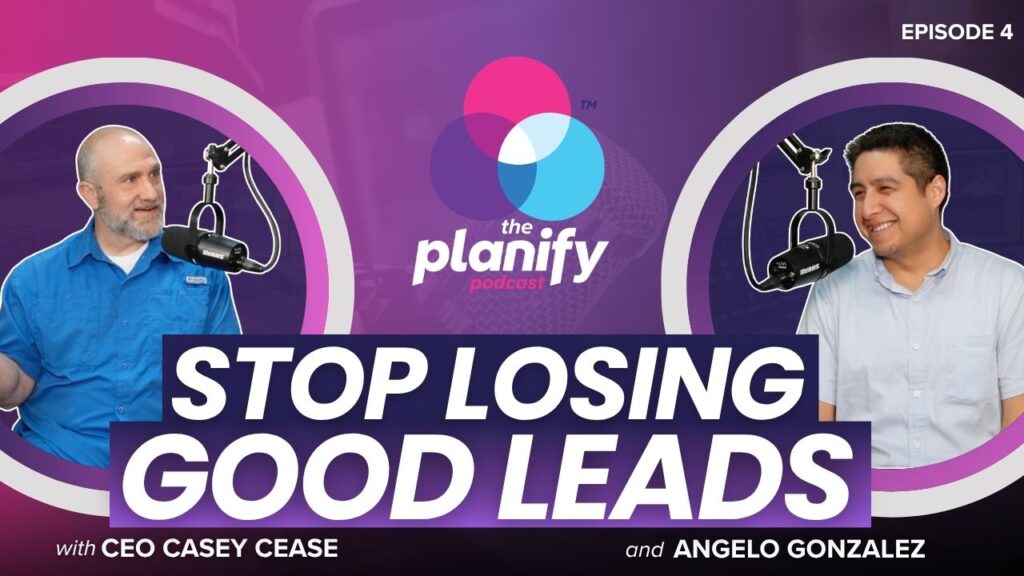
In Episode 4 of the Planify Podcast, we dive deep into the operational failures that cause high-intent prospects to slip through the cracks, and more importantly, how to plug the holes in your sales pipeline so you can scale efficiently.
Listen on Your Favorite Platform
If your business is struggling to close the leads you are already paying for, this comprehensive guide will break down exactly why your follow-up system is failing, the psychology behind speed-to-lead, and the exact operational framework you need to fix it.
Part 1: Diagnosing the Leaky Bucket Syndrome
What is the Leaky Bucket?
Imagine your business as a bucket. The water pouring into it represents your marketing efforts—your website traffic, inbound calls, form fills, and social media inquiries. The water settling at the bottom represents your converted clients and captured revenue.
The Leaky Bucket Syndrome occurs when that bucket is riddled with holes. You are spending massive amounts of capital, time, and energy to turn on the faucet (marketing), but the water is pouring right out of the sides (poor operations).
Instead of fixing the holes, most business owners simply try to turn the faucet on higher. They spend more money on ads to offset their abysmal closing rates. This is mathematically unsustainable. As your customer acquisition cost (CAC) continues to rise, the leaks in your bucket will eventually drain your profit margins completely.
A Real-World Example: The Friction of the Handoff
During the podcast, we discussed a real-world example of this exact phenomenon. A founder we met had built a highly successful lead generation system for personal injury lawyers. He was capturing high-intent leads—people who had just been in accidents and urgently needed legal representation—and passing them directly to the law firms.
However, he encountered massive frustration. The law firms were complaining that the leads were “bad” or “cold.”
When we dug into the operations, the reality was starkly different. The leads were excellent; the follow-up was atrocious. The law firms were waiting 24 to 48 hours to call these individuals back. By the time the firm’s intake team finally picked up the phone, the prospect had already Googled another lawyer, called them, and signed a retainer.
The marketing was flawless. The operational follow-up was broken. The bucket was leaking.
Part 2: The Math and Psychology of “Speed-to-Lead”
To understand how to patch the leaks in your pipeline, you must first understand the fundamental concept of Speed-to-Lead.
Speed-to-lead refers to the amount of time it takes your business to respond to an inbound inquiry. In the digital age, consumer patience is practically nonexistent. We live in an era of Amazon Prime delivery, instant streaming, and on-demand services. When a consumer reaches out to a business—whether it’s a roofing company, a marketing agency, or a medical clinic—they expect an immediate response.
The 5-Minute Rule
If a prospect fills out a form on your website and you call them within 5 minutes, your odds of qualifying that lead and moving them into your sales pipeline are exponentially higher than if you wait 30 minutes. If you wait 24 hours, the lead is practically dead.
Why? Because of consumer psychology. When a person fills out a form, they are in a state of active problem-solving. They have identified a pain point and are actively seeking a solution. If you interrupt that state of active seeking with a delayed response, their emotional urgency fades, or worse, a faster competitor capitalizes on it.
The Cost of Hesitation
Every minute that passes between a lead coming in and your team reaching out drastically increases your Customer Acquisition Cost. You have already paid for that lead. The Google Ad budget was spent. The SEO retainer was paid. When your sales team fails to follow up promptly, they are literally burning marketing capital.
Many businesses justify their slow response times by claiming they are “too busy” fulfilling current client work. While operational capacity is a real challenge, you cannot scale a business if your growth engine is constantly stalling out due to internal friction.
Part 3: Redefining Follow-Up as Elite Customer Service
One of the biggest mental hurdles business owners and sales teams face is the fear of “bothering” the prospect. Sales professionals often hesitate to follow up multiple times because they don’t want to seem pushy, desperate, or annoying.
At Planify, we vehemently reject this mindset. We believe that prompt, persistent follow-up is the first step of exceptional customer service.
Shifting the Paradigm
If you truly believe in the product or service you sell—if you genuinely believe that your business can solve the prospect’s problem better than anyone else in the market—then it is your duty to follow up with them.
When a prospect reaches out to you, they are raising their hand and saying, “I have a problem, and I think you can fix it.” If you do not follow up, you are abandoning them to their problem. You are forcing them to either live with their pain point or go to a competitor who may not serve them as well as you could have.
When you reframe follow-up from “trying to extract money from a lead” to “proactively serving a person in need,” the entire tone of your sales process changes. It becomes human, empathetic, and relentlessly helpful.
Building Authority Through Consistency
Furthermore, your follow-up process sets the tone for the entire client relationship. If your prospect experiences a chaotic, delayed, and disorganized intake process, they will subconsciously assume that your fulfillment and service delivery will be equally chaotic.
Conversely, if you respond immediately, follow up consistently with valuable information, and guide them smoothly through the buying process, you establish immense authority and trust before the contract is even signed. You prove that you are a competent, reliable operation.
Part 4: The 3-Step Framework to Patch the Leaky Bucket
Identifying the Leaky Bucket Syndrome is the easy part. Fixing it requires intentional, documented operational changes. You cannot simply tell your team to “follow up faster.” You must build a system that guarantees it happens.
Here is the exact 3-step framework we use at Planify Agency to help our clients patch their pipelines and maximize their marketing ROI.
Step 1: Document the Manual Process
The most common mistake business owners make when trying to fix their follow-up is immediately buying an expensive Customer Relationship Management (CRM) software or AI chatbot, hoping technology will magically solve the problem.
Do not automate a broken system. If you automate a bad process, you will simply lose leads faster and more efficiently.
Before you touch a piece of software, you must document your ideal, manual follow-up process. Grab a whiteboard or a blank document and map out the exact customer journey:
- Minute 0: Lead fills out the form.
- Minute 5: Who is responsible for calling them? What is the script?
- Hour 24: If they didn’t answer, what is the exact text message or email that goes out?
- Day 3: What is the subsequent touchpoint? Is it a value-add email with a case study?
You must define the cadence, the medium (phone, email, text), and the messaging for the first 14 to 30 days of the lead’s lifecycle. Document this process so clearly that a brand new hire could look at it and execute it flawlessly.
Step 2: Implement Transparent Tracking
Once the process is documented, you must establish a single source of truth for tracking. You cannot fix what you cannot measure.
Whether you use a robust CRM like HubSpot or Salesforce, or a simple organized spreadsheet, every single lead must be tracked. You need to know:
- Lead Source: Where did they come from? (Google Ads, organic search, referral?)
- Current Stage: Where are they in the pipeline? (Attempted contact, meeting booked, proposal sent?)
- Next Action Date: When is the exact date and time the next follow-up must occur?
- Owner: Which specific human being on your team is responsible for that next action?
If a lead exists in your system without a defined “Next Action Date” and a designated “Owner,” that lead has fallen into the leaky bucket and is officially lost.
Step 3: Integrate Human-Centric Automation
Only after you have a documented process and a tracking system in place should you introduce automation.
Automation should be used to eliminate administrative friction and ensure speed-to-lead, not to replace the human element of sales.
For example, you can use automation to:
- Instantly trigger an internal Slack or text notification to your sales team the second a lead form is submitted.
- Send a personalized, automated email and text message to the prospect immediately, acknowledging their inquiry and providing a calendar link to book a call.
- Set up automated task reminders for your sales reps to call the prospect on Day 2, Day 5, and Day 10.
The goal of automation is to tee up the human interaction, ensuring that your team can focus their energy on building relationships and having high-level conversations, rather than getting bogged down in data entry.
Part 5: The Retention Imperative — Stopping Leaks Post-Sale
While the Leaky Bucket Syndrome is most commonly associated with the front-end sales pipeline, it is equally destructive on the back end: client retention.
You can have the best marketing in the world, and a flawless, lightning-fast follow-up system, but if your product or service delivery is poor, your clients will churn.
Acquiring a new customer is significantly more expensive than retaining an existing one. If you are constantly losing clients due to poor communication, missed deadlines, or lack of results, you are still suffering from the Leaky Bucket Syndrome.
The Onboarding Experience
The follow-up process does not end when the invoice is paid; it merely transitions into the onboarding process. The first 30 days of a new client’s experience will dictate the lifetime value of that relationship.
Do you have a documented process for welcoming them? Do you set clear expectations? Do you communicate proactively, or do you wait for them to ask you for updates? By applying the same rigorous, documented systems to your client fulfillment that you applied to your sales follow-up, you will dramatically increase retention, boost lifetime value, and generate organic referrals.
The Bottom Line: Strategy Before Tactics
At Planify Agency, our core philosophy is that tactics fail without strategy. Throwing money at a new Facebook ad campaign or hiring an SEO specialist are just tactics. If the underlying operational strategy—your lead follow-up system, your CRM management, your speed-to-lead protocols—is broken, those tactics will yield a negative return on investment.
Stop accepting the illusion that you simply need “more leads.” Look critically at your operations. Audit your pipeline. Call your own business as a secret shopper and see how long it takes your team to respond.
When you fix the leaks in your bucket, a miraculous thing happens: you realize you don’t need to double your marketing budget to double your revenue. You just need to respect, serve, and close the leads you already have.
Ready to Plug the Leaks in Your Business?
If you are tired of watching your marketing dollars slip through the cracks of a broken operational system, it is time to build a documented, scalable growth strategy.
At Planify Agency, we don’t just run ads; we audit your backend, rebuild your sales pipelines, and align your marketing with elite operational frameworks.
Schedule your custom Business Growth Diagnostic Session today. Connect with the Planify Team:
- Follow Planify Agency on LinkedIn
- Follow Planify Agency on Instagram
- Connect with Casey Cease on LinkedIn
- Connect with Angelo Gonzalez on LinkedIn