
How does an entrepreneur survive an immediate, catastrophic 80% drop in top-line revenue and emerge with a business that is three times larger, highly automated, and positioned for generational wealth?
When the subprime mortgage crisis collided with the global financial sector in 2008, the traditional real estate landscape didn’t just contract—it completely shattered. For service-based business owners, transactional brokers, and capital-dependent entrepreneurs, the crash was an existential filter. Those who relied strictly on outdated marketing models and manual backend operations were eliminated. Those who adapted survived.
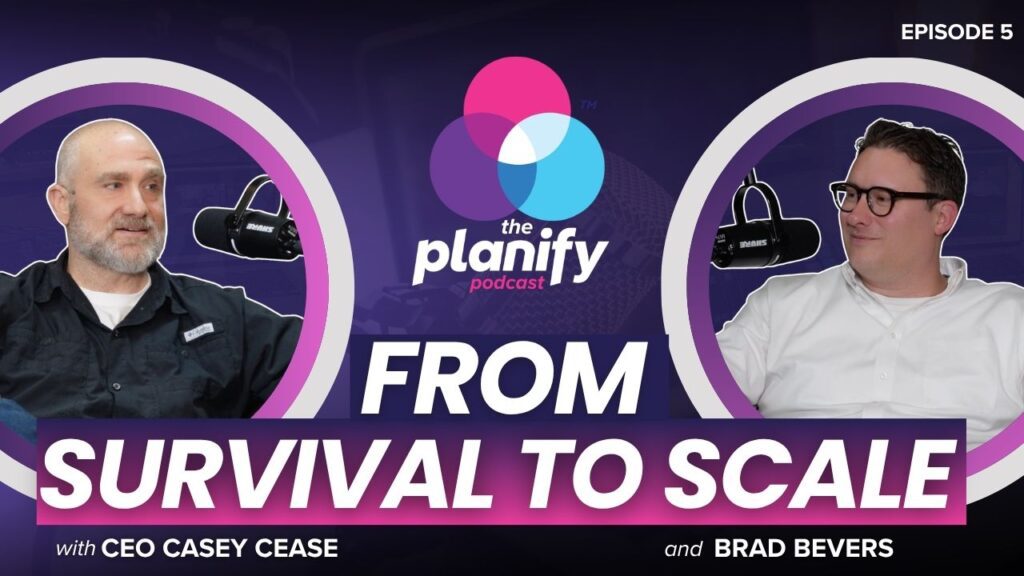
In Episode 5 of The Planify Podcast, host Casey Cease sat down with Brad Bevers—a veteran Texas real estate broker, sophisticated angel investor, and principal of Bevers Real Estate—to deconstruct a masterclass in modern entrepreneurship.
This deep dive extracts the operational playbooks, risk-mitigation frameworks, and behavioral shifts Bevers utilized to navigate macroeconomic destruction, transition a multi-generational legacy company, and implement a hyper-efficient backend partnership that slashed his personal operational workload by 50% while tripling company revenue.
Listen on Your Favorite Platform
1. Macroeconomic Survival: Rebuilding Capital via Low-Cost Arbitrage
When the 2008 recession struck, Bevers was a young broker operating within a traditional, hyper-local independent real estate firm in Brenham, Texas. Within a matter of months, traditional transactional volume dried up entirely, triggering an 80% reduction in personal income.
The Survival Playbook: Embracing Short-Term Asymmetry
Faced with zero transactional momentum in the real estate sector, Bevers avoided the classic psychological trap of waiting for market correction. Instead, he identified immediate, low-cost capital-generation channels completely detached from his primary business sector.
Leveraging early internet-era arbitrage, Bevers recognized a localized market mismatch in out-of-print textbook and niche manual distributions. By systematically purchasing undervalued inventory at local asset clearances and thrift networks, and reselling them across emerging digital platforms like Amazon and eBay, he built an agile side hustle that generated over $30,000 in liquid capital during the darkest phases of the credit crunch.
The Strategic Lesson for Modern CEOs
In a shifting economic climate, rigid dedication to a single, broken revenue stream is a structural liability. When market conditions freeze your core product, your immediate objective is capital preservation and baseline liquidity. Utilizing high-margin, low-overhead arbitrage plays allows you to maintain personal cash reserves without diluting or taking on predatory debt against your primary corporate entity.
2. The Microbook Framework: Engineering Sustainable Authority Marketing
As the broader market began its multi-year stabilization process, Bevers returned his operational focus entirely to real estate. However, the pre-2008 customer acquisition playbooks—cold calling, expensive institutional billboard placements, and generic local advertisements—were yielding diminishing returns.
To achieve true market distinction, Bevers bypassed standard marketing tactics and executed an Authority Marketing strategy: he wrote a highly targeted, hyper-utility microbook focused specifically on country real estate and land management.
Deconstructing the Asset Engine
A microbook is not designed to be a 400-page literary masterpiece. It is an optimized, high-intent corporate brochure engineered to solve the top three to five systemic pain points of a highly qualified prospective client.
Bevers identified that high-value landowners across South-Central Texas frequently struggled with specific regulatory, structural, and valuation challenges unique to rural acreage. By codifying actionable solutions into a professional, physical booklet, he built a marketing asset that acted as an ultimate business card.
Execution Plan: The Direct-Mail Flywheel
Instead of waiting for organic retail distribution, Bevers ran a targeted outbound campaign:
- He acquired highly specific geographic mailing lists consisting exclusively of regional landowners holding substantial acreage positions.
- He systematically distributed the physical book directly to their mailboxes.
- The messaging established automatic authoritativeness. When these landowners eventually prepared to sell multi-million-dollar land positions, they bypassed traditional real estate listings and directly contacted the recognized author who had already educated them on the process.
Planify Core Strategy Alignment: This is the practical execution of building mental availability. In competitive industries, your brand must be top-of-mind the exact moment a prospect transitions into a buying state. A physical book creates continuous, passive authority on a client’s desk in a way a digital ad never can.
3. Generational Business Integration and the Strategic Corporate Buyout
Many small-to-midsize businesses stumble during leadership transitions. Bevers Real Estate was originally established by Brad’s grandparents, operating under legacy business methodologies tailored for a mid-20th-century market. Transitioning a legacy corporate entity into a modern, high-growth apparatus requires an extreme level of operational tact, diplomatic leadership, and strategic financial planning.
The Phased Leadership Transition Blueprint
Bevers did not attempt an overnight corporate coup. Instead, he designed a multi-stage integration and buyout framework:
- Phase 1: Active Shadowing & Skill Absorption: Early in his career, Bevers spent thousands of hours directly shadowing his grandfather during client consultations, asset inspections, and negotiations. This allowed him to absorb decades of uncodified relationship equity and historical localized data.
- Phase 2: Gradual Operational Integration: He slowly introduced contemporary tech stacks, digital marketing channels, and scalable recruitment frameworks while respecting the foundational core values of the established brand.
- Phase 3: The Clean Equity Split: When the formal buyout occurred, it was structured to allow the founding generation a dignified, financially secure exit while granting Brad complete operational freedom to scale the business model into a multi-agent powerhouse.
4. The Scaling Bottleneck: Tripling Top-Line Revenue via Backend Outsourcing
As Bevers scaled the firm from an independent family practice up to a robust group of 24 active real estate agents, he collided with the universal ceiling of business growth: The Operational Bottleneck.
As a CEO’s business expands, their personal time is increasingly consumed by non-revenue-generating administrative burdens: legal compliance, changing technological infrastructure, insurance overhead, accounting audits, and human resource management. Every hour an executive spends reviewing a compliance document or fixing a software integration is an hour stolen from high-value strategic growth and deal-making.
The Side Partnership: A Case Study in White-Label Leverage
To smash through this operational ceiling, Bevers executed a game-changing organizational pivot: he partnered with Side, an innovative, venture-backed brokerage platform engineered to completely manage the backend operations for premier boutique real estate firms.
Under this structure, Bevers Real Estate retained 100% ownership of its local brand, its independent culture, and its customer-facing operations. Meanwhile, Side assumed complete liability and execution responsibilities for:
- Broker-of-record legal compliance and transaction auditing.
- Advanced real estate technology integrations and platform scaling.
- Invoicing, vendor coordination, and back-office administrative workflows.
The Quantitative Financial ROI
The results of offloading these operational liabilities were immediate and dramatic:
- Executive Time Reclaimed: Brad Bevers’ personal operational workload was instantly slashed by 50%.
- Top-Line Revenue Multiplication: Freed from administrative work, Bevers shifted his focus to high-level talent acquisition and market expansion. The business surged, tripling its total transactional revenue.
- Risk Mitigation: The burden of corporate compliance and shifting legal regulations was fully transferred to a specialized, multi-million-dollar platform equipped with dedicated corporate counsel.
5. Shifting from Transactions to Equity: The Asymmetrical Angel Investor Mindset
One of the most profound transitions an entrepreneur can make is shifting from a transactional service mindset to an equity-driven investor mindset.
As a successful real estate broker, Bevers recognized that standard commission structures (the traditional 3% fee) represent linear income. You work a transaction, you get paid once, and you reset to zero. To build true, multi-generational wealth, a business leader must convert immediate transactional cash flow into long-term, compounding capital assets.
Understanding Asymmetrical Risk Management
As Bevers expanded his financial footprint into private equity and angel investing, he adopted a strict framework centered on asymmetrical risk. An asymmetrical bet is an investment structure where the quantifiable downside is strictly capped, while the prospective upside is exponentially larger.
When evaluating early-stage venture opportunities, angel investments, or regional commercial developments, Bevers asks a core set of operational questions:
- If this venture completely fails, will the loss impair my core business operations or long-term financial security? (If yes, abort immediately.)
- Does this investment leverage my unique, unfair regional advantages or historical business data?
- Is the upside potential a compounding multiplier, or is it merely an incremental linear return?
By utilizing a strong cash flow cushion generated from his scaled, outsourced real estate business, Bevers gained the ultimate competitive advantage in investing: The Illiquid Edge. He could afford to deploy capital into long-term, illiquid private assets that standard investors couldn’t touch, allowing him to capture massive equity growth over five-to-ten-year horizons.
6. The “Yes” Philosophy of Early Entrepreneurship
Modern business advice is heavily saturated with the concepts of absolute focus and the power of saying “no.” While that framework is highly effective for scaled CEOs managing billion-dollar portfolios, Bevers challenges its validity for early-stage founders.
The Experimental Phase of Growth
When you are in the first three to five years of building an entrepreneurial career, saying “no” too early is a growth-limiting mistake. The early phase of business requires massive experimentation, high-speed feedback loops, and broad knowledge acquisition.
By saying “yes” to diverse real estate deals, varied side business ventures, local service opportunities, and unique partnerships early on, Bevers constructed an expansive network, built essential capital cushions, and discovered exactly where his unique market advantages existed. Only after you have built a foundation of diversified experience do you earn the operational right to pivot into hyper-focused pruning and selective optimization.
7. Building an Integrated Legacy: Balancing Family, Faith, and Future Vision
For the Planify leadership team, true scale is never measured purely by bottom-line financial statements. True success requires total alignment across all dimensions of an entrepreneur’s life: corporate growth, family dynamics, and personal faith values.
The Shadowing Model for Generational Family Leadership
Drawing inspiration from intentional family architecture systems, such as the frameworks outlined in Jeremy Pryor’s book Family Revision, Bevers actively structures his lifestyle to integrate his three sons directly into his daily work.
Instead of separating his career from his family life behind an artificial boundary, Bevers brings his sons directly into his operational world:
- They walk land tracts, observe high-stakes negotiations, and assist with hands-on asset management.
- They experience the raw realities of business operations, witnessing firsthand how strategic plans are translated into real-world execution.
This intentional shadowing model ensures that his sons aren’t merely inheriting financial capital down the road—they are systematically inheriting the behavioral attributes, risk tolerances, and ethical foundations required to manage and expand that wealth over their lifetimes.
The 5-Year Vision: Integrating AI Frameworks for Local Growth
Looking toward the horizon, Bevers’ strategic trajectory focuses on combining established regional values with modern technology. Over the next three to five years, his goal centers on carefully scaling his agent network while integrating cutting-edge, artificial intelligence tools provided through the Side ecosystem to maximize local market intelligence, automate predictive listing analytics, and deliver elite consumer experiences.
Simultaneously, as an elder alongside Casey Cease at Redeemer Church in Brenham, Bevers channels his operational systems back into community growth, helping guide a major physical building infrastructure campaign designed to support a local church community that has the potential to double its scope within the next five years.
Key Takeaways for Immediate Implementation
To scale your corporate entity like a premier Texas brokerage firm, apply these core structural steps:
- Deploy an Authority Marketing Asset: Stop competing on price and generic lead-generation channels. Write and distribute a highly targeted microbook that establishes immediate expertise within your target market.
- Audit Your Bottlenecks for Backend Outsourcing: Identify the administrative, legal, and operational tasks consuming your time. Partner with specialized platforms or fractional asset agencies to offload compliance, freeing you up to focus 100% on revenue generation.
- Run an Asymmetrical Risk Audit: Ensure your cash reserves are diversified into high-upside equity positions where your potential downside is strictly capped.
- Adopt a Comprehensive Legacy Framework: Intentionally integrate your family, personal faith, and long-term values directly into your business model to build a deeply rooted, resilient company structure.
Scale Your Business with Planify
Are your growth goals currently hitting an operational ceiling? Are you trapped handling the tedious administrative burdens of your business instead of driving high-level strategic scaling?
At Planify Agency, we engineer custom growth architectures, advanced lead flywheels, and end-to-end marketing systems designed to eliminate operational friction and maximize your enterprise value.