
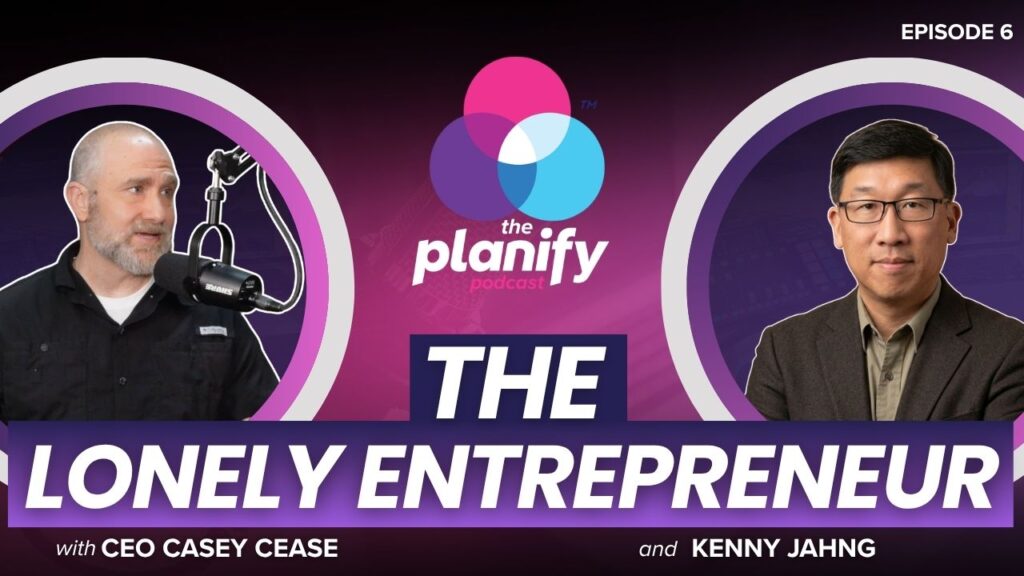
Entrepreneurship is frequently glorified as a journey of total independence, endless freedom, and autonomous success. Yet, behind the polished LinkedIn updates and revenue milestones, a quiet crisis is unfolding. Business leaders are navigating an unprecedented era of professional isolation. When you combine this “loneliness epidemic” with the overwhelming, rapid advancement of technologies like generative Artificial Intelligence, it creates a perfect storm for executive burnout and operational stagnation.
In this episode of the Planify Podcast, CEO Casey Cease sits down with Kenny Jahng—a seasoned entrepreneur, community builder, and AI strategist. Kenny brings a fascinating, multi-disciplinary background to the table. Having transitioned from the high-stakes world of Fortune 100 corporate marketing and PR into the nonprofit and ministry sector (earning an MDiv along the way), Kenny has spent years translating elite, enterprise-level business principles for the “everyday entrepreneur.”
This deep-dive conversation tackles two distinct but deeply connected challenges: the necessity of building authentic, vulnerability-driven communities, and the strategic imperative of learning new technologies collaboratively.
Here is a comprehensive breakdown of the strategies discussed to help you combat isolation, rehumanize your networking, and leverage AI to scale your business operations effectively.
Listen on Your Favorite Platform
The Plight of the Everyday Entrepreneur
The business landscape is often polarized. On one end of the spectrum, there are endless entry-level courses and basic tutorials for complete beginners. On the other end, there are elite, high-ticket masterminds reserved for those who are already generating massive, eight-figure revenues.
But what about the leaders in the middle?
The “everyday entrepreneur” is the leader who is grinding it out day-to-day, managing payroll, figuring out local market dominance, and trying to build standard operating procedures (SOPs) that actually work. For these individuals, the journey is incredibly uncharted. There is no standard instruction manual for scaling a local business while maintaining your sanity.
Kenny identified this gap early in his career. Drawing from his MBA and Fortune 100 background, he recognized that the most vital missing component for the everyday business owner wasn’t necessarily more capital or a better marketing funnel—it was a community of peers.
The Power of the Mastermind Framework
When leaders operate in silos, they are limited by their own perspective and experience. Mastermind groups solve this by creating a collective intelligence. However, the true value of a mastermind does not lie in everyone showing up to brag about their recent financial wins.
As Casey noted during his experience at one of Kenny’s mastermind retreats, the real breakthrough happens when leaders put down their armor. The environment must allow entrepreneurs to say, “Here is where I am struggling. Here is where I completely messed up. I don’t know what to do next.”
When failure is repositioned as a shared learning experience rather than an individual defeat, the entire group accelerates. You learn to avoid the costly mistakes your peers have already made, saving you thousands of dollars and months of wasted effort.
Confronting the Loneliness Epidemic in Leadership
To understand why these communities are so crucial, we have to look at the broader cultural context. We are currently facing a severe loneliness epidemic, and it is disproportionately affecting adult men and business leaders.
Kenny highlighted a chilling statistic: more than 15% of adult men report having zero close friends. They do not have a single person they can call during a crisis or rely on for genuine, non-transactional support. In the high-pressure world of business ownership—where your frequency of thinking and risk tolerance is vastly different from the average employee—this isolation is amplified.
The Post-Pandemic Relational Deficit
The pandemic fundamentally altered our relational capacity. While there were positive aspects to slowing down, it also allowed many to retreat into a comfortable, isolated shell. We lost the necessary friction of in-person social interactions.
Furthermore, social media algorithms have trained us to self-edit and seek out echo chambers. We interact with people who perfectly align with our views, making the prospect of engaging with diverse, complex human beings feel unnecessarily risky. As we age, the energy required to initiate a new relationship and navigate differing preferences feels exhausting. We have developed a “relational budget,” and for many leaders, that budget is bankrupt.
The “Let Me” Theory: Reclaiming Agency
If you are an entrepreneur waiting for a community to organically form around you, you will be waiting forever. As Kenny astutely points out, friendship and community go from being a “group sport” in childhood to an “individual sport” in adulthood.
To overcome this, leaders must adopt what Mel Robbins calls the “Let Them” theory, but with Kenny’s proactive twist: The “Let Me” Theory.
You have agency. You must be the one to steer the relationship. Building a network requires three pillars: proximity, timing, and energy. If you let any of those drop, the relationship drifts. You cannot wait for others to invite you in; you must be willing to go first.
Strategic Action Step: Challenge yourself to invite an acquaintance—someone on the fringes of your network—over for dinner or out for coffee once a month. The budget is minimal (the cost of an extra serving of pasta), but the ROI on building the social scaffolding of a community is immeasurable. Rehumanize your interactions before you ever attempt to do business with them.
The Abundance Mindset in Professional Networking
This proactive, human-first approach is desperately needed in local networking groups. Too often, business owners walk into a local chamber of commerce or an industry collaboration group operating from a mindset of deep scarcity.
Casey utilized a perfect analogy: the difference between a trophy hunter and a meat hunter. Many entrepreneurs enter a room looking at everyone as a potential meal—a lead to be captured and converted immediately to ensure their survival. They pull out their proverbial pitch deck and start hunting.
This behavior is incredibly off-putting and destroys the purpose of community. Networking groups are not hunting grounds; they are ecosystems. When you approach a room with an abundance mindset, you view the people there as peers to learn from, collaborate with, and support. The business will naturally follow the relationship, but if you prioritize the transaction over the connection, you will remain isolated.
Entering the Age of Generative AI
The necessity of learning together becomes glaringly obvious when we examine the current landscape of Artificial Intelligence. Since the launch of highly capable generative models in late 2022, the business world has been in a state of whiplash.
Many local business owners are overwhelmed. They hear about AI daily, but they have no idea how it specifically applies to their service-based businesses, local agencies, or retail shops. Because they don’t understand the complex mechanics of Large Language Models (LLMs), they assume they are too far behind to catch up.
Permission to Be a Beginner
Kenny’s primary advice for entrepreneurs facing AI paralysis is simple: Give yourself permission to be a beginner.
The technology is incredibly new. Every self-proclaimed “AI Guru” on LinkedIn was completely lost a year and a half ago. The gap between your current knowledge and the frontier of AI application is much smaller than you perceive. However, the only way to close that gap is to get your hands dirty. There is no comprehensive textbook you can read to master this; you simply have to log in and put in the reps.
The Claude Collective
To facilitate this learning, Kenny launched the Claude Collective—a group specifically dedicated to mastering Anthropic’s highly capable AI, Claude.
This circles back to the mastermind principle: AI is moving too fast for any single operator to figure out alone. By gathering a group of operators, builders, and leaders to share their workflows, prompts, and failures, the collective intelligence network effect takes over. When one member spends a week failing to build an automation, they share that failure, saving everyone else in the group a week of lost time.
Strategic AI Implementation for Your Business
If you are ready to start leveraging AI, you must do so strategically. Implementing advanced technology without a solid business foundation will only cause chaos.
Here are the core Planify strategies for adopting AI in your daily operations:
1. Do Not Automate a Bad Process
This is the golden rule of business technology. AI is an amplifier. If you have a poorly designed lead follow-up system (what we call the “Leaky Bucket” syndrome), unleashing an AI agent on it will simply automate your poor customer service at scale.
Using AI effectively forces you to return to your basic business fundamentals. Before you open an AI tool or string together an automation in Zapier, you must manually map out your standard operating procedures. What is the exact customer journey? What are the repetitive, manual tasks that create bottlenecks? Only once the process is clarified on a whiteboard should you apply AI to handle the heavy lifting.
2. Help the AI Help You (The Inception Method)
You do not need a degree in prompt engineering to get started. Treat the AI like a highly capable, slightly literal intern. If you don’t know where to start, ask the AI to guide you.
Kenny refers to this as the “Inception” method. Open Claude or ChatGPT and type: “I am a local business owner looking to use AI to improve my marketing and operations. I don’t know where to start. Please ask me a series of questions about my business so you can give me a customized starting plan.”
Let the technology do the analytical heavy lifting to build your roadmap.
3. Focus on Reclaiming Time, Not Replacing People
The goal of AI in a small or local business is not to dehumanize your brand or replace your team. The goal is to reclaim the hours spent on tedious, repetitive tasks so that you and your staff can focus on what actually moves the needle: building high-value, human relationships.
Use AI to draft your email newsletters, outline your blog posts, summarize your long meeting notes, and structure your data. By offloading the operational friction, you free up your mental energy to be the visionary leader your business requires.
The Unfair Advantage
We are living in a unique transitional moment in business history. The landscape is shifting beneath our feet.
The entrepreneurs who choose to remain isolated, viewing their peers as competition and ignoring the technological advancements in front of them, will find the next few years incredibly difficult.
However, the leaders who actively build community, embrace vulnerability, and commit to learning tools like AI alongside their peers will experience unprecedented growth. As Kenny Jahng perfectly stated, those who figure this out over the next 12 months will not just have an advantage—they will have an unfair advantage.
Ready to Scale Your Business Without the Stress?
If you are overwhelmed by the idea of implementing new systems, fixing your lead follow-up, or figuring out how AI fits into your specific operations, you do not have to do it alone. The team at Planify Agency is dedicated to helping you build solid business models, iron-clad brands, and automated operations.
Book your complimentary Strategy Session today, and let’s map out your growth blueprint.
Explore the Resources Mentioned in This Episode:
- The Let Them Theory: Listen to Mel Robbins’ concept here
- Explore Claude AI: Anthropic’s Claude
- Automate your workflows: Zapier
- Join the AI Community: The Claude Collective
- Resources for Ministry Leaders: AI for Church Leaders
Connect with Our Guest:
- Kenny Jahng on LinkedIn
- Kenny Jahng on Instagram
- Kenny Jahng on Twitter
- Kenny Jahng on Facebook
- Kenny Jahng’s Website
Connect with the Planify Team:
- LinkedIn: Follow Planify Agency
- Instagram: @planifyagency
- Facebook: Planify Agency
- YouTube: Subscribe to Planify
- TikTok: @planifyagency
- Connect with Casey Cease: LinkedIn