
If you’ve been running paid ads for your online business over the last year or so, there’s a decent chance something has felt off, even when the numbers looked fine on the surface. Lead volume stayed steady. Cost per acquisition looked reasonable. But then the quality started slipping, the sales team started pushing back, and nobody could quite explain why.
That’s not a you problem. That’s a Meta problem. And it’s been affecting experienced ad buyers and their clients across the board.
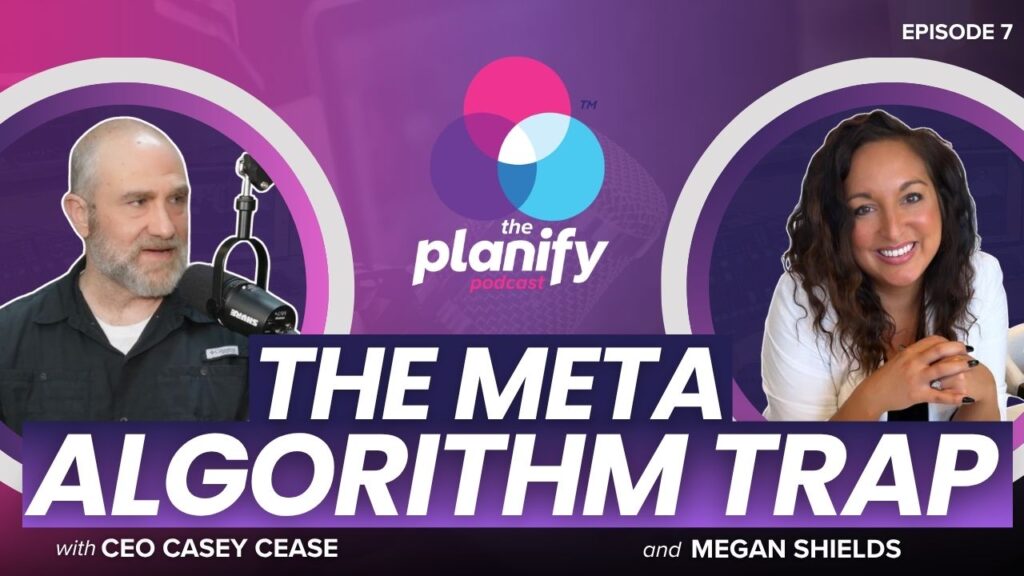
In Episode 7 of The Planify Podcast, I sat down with Megan Shields, founder and CEO of Chimehouse Media, to talk through what’s actually happening inside the paid ads ecosystem right now, and more importantly, how smart operators are adjusting. Megan brings six years of hands-on ad buying experience, primarily in the online business space: digital courses, coaching programs, live launches, and webinar funnels. She’s seen the platforms evolve, and she knows how to read the shifts before they become crises.
Listen on Your Favorite Platform
What’s Actually Happening With Meta Right Now
If you’ve tried to keep up with Meta’s official announcements, you’ve probably noticed they’re not exactly forthcoming. There’s a blog where they occasionally surface updates, but it doesn’t capture everything, and what it does publish isn’t always easy to interpret. Even when Casey ran some of Meta’s recent announcements through AI tools to try to decode them, the AI came back uncertain.
Megan put it plainly: “It’s a very reactive situation because they don’t tell us what they’re doing.”
The experience she described, and one that resonated closely with our own at Planify, is less like piloting a well-tuned machine and more like troubleshooting a breakdown in real time. You start noticing things are off, you go digging, and by the time you’ve found the problem, the platform has already moved on to something else.
The March 2025 update is a good example. No announcement. No documentation. Just a quiet shift that eroded lead quality for campaigns that had been running cleanly for months. Two weeks in, clients started flagging it. And at that point, the damage was already done.
This isn’t a reason to abandon paid advertising. But it is a reason to think differently about how you structure your strategy around it.
The Advantage+ Problem
Part of what’s changed is Meta’s aggressive push toward Advantage+ campaigns, their AI-driven, automated ad delivery system that progressively removes manual targeting controls in favor of machine learning.
In theory, it’s meant to improve performance by letting Meta’s algorithm find the right audience for you. In practice, for businesses in specialized niches like online coaching, high-ticket digital programs, and B2B services, it often creates a mismatch between who sees the ad and who actually qualifies to buy.
Megan’s take was direct: “Meta is getting more into their Advantage Plus, more into their AI, and more into the ‘trust us’ mode, which I don’t love.”
For ad buyers who’ve spent years understanding customer psychology and engineering targeting around it, handing that control over to an algorithm that doesn’t know your offer, your client, or your sales process is a real limitation. It’s not that automation is useless. It’s that it works better when it has good inputs. And right now, a lot of businesses don’t have the infrastructure in place to give it those inputs.
Building Audience Strategy That Doesn’t Depend on Meta Alone
So what’s the workaround? For Megan and the Chimehouse Media team, the answer has been to invest in data infrastructure that operates independently of Meta’s native targeting.
The first move was investing in a data platform that builds custom audiences of high-intent users, people who are already in market for what a client sells. Instead of relying on Meta’s algorithm to find the right people, you bring a pre-qualified audience to the campaign. That changes the dynamic considerably.
The second move was using audience-building tools that allow you to pull from competitor pages, competitor followings, and competitor Facebook groups. If someone is already engaged with a similar offer in the same space, they’re a warmer prospect than a cold algorithmic match.
This kind of audience strategy, building from intent signals rather than demographic assumptions, is increasingly how experienced buyers are maintaining performance in a less controllable ad environment.
Revenue Optimization: The Growth Lever Most Businesses Ignore
Here’s where the conversation shifted into territory that’s arguably more valuable than any platform-specific tactic.
One of the most common conversations in paid advertising circles is about lead cost. Clients want cheaper leads. Ad buyers work to lower CPL. And while that’s not a bad instinct, Megan made a point that’s worth sitting with:
“Shaving a couple bucks off of a lead is not going to move the needle in your business. But if you can add more revenue to people that are already working with you, or add something in on the back end, that can really move the needle.”
She walked through the math with a simple example. If you’re running a webinar funnel and selling a $2,000 program, your focus on trimming the $8 cost-per-lead down to $5 saves you $3 per lead. Over a thousand leads, that’s $3,000. Not nothing, but not transformational either.
Now consider what happens when you add a $1,000 back-end offer after the initial purchase, and then a 12-month membership at, say, $500 per month. A customer who originally represented $2,000 in revenue now represents $8,000 or more in lifetime value. That’s the number worth engineering.
This is what Megan means by revenue optimization. Not a dashboard metric, but a structural look at the full customer journey. Where are people entering? Where are they dropping off? What’s the cost to acquire them, and what’s the realistic revenue they can generate over time? Most businesses, she pointed out, are so focused on the top of the funnel that the back end never gets the attention it deserves.
For a deeper framework on customer lifetime value and funnel architecture, HubSpot’s guide to CLV is a useful reference point.
Identifying Bottlenecks Before They Cost You
Connected to revenue optimization is the discipline of bottleneck diagnosis, something Megan approaches almost intuitively at this point, though the logic behind it is straightforward.
Every customer journey has stages, and each stage has a conversion rate. When a business is underperforming, it’s rarely because every stage is broken. Usually there’s one or two points in the process where the handoff falls apart: a landing page that doesn’t convert, a sales call that doesn’t show up, a follow-up sequence that goes cold.
The mistake most businesses make is throwing more ad spend at a funnel that has a structural problem. More traffic into a broken funnel just means more wasted money.
Megan’s approach is to look at the whole system before touching the budget. What’s the cost per lead? What’s the show-up rate on calls? What’s the close rate? Where does the gap between intent and action appear? Once you locate the break, fixing it is usually far less expensive than trying to overpower it with volume.
This kind of diagnostic thinking, tracking meaningful numbers across the funnel rather than just front-end metrics, is what separates businesses that grow from businesses that spin.
How Megan Is Pivoting Chimehouse Media
The algorithmic pressure on Meta isn’t just an inconvenience for Megan’s clients. It’s reshaping her own business model. And the way she’s approached that transition is worth paying attention to.
Rather than overhauling everything at once, she’s testing new channels while keeping existing client work intact. The primary test right now is outbound email marketing, using the same intent-based data platforms she’s deploying for clients to build targeted lists and run cold outreach sequences that book calls.
The early results were strong: a 2 to 2.2% response rate on cold emails, a 100% call show-up rate, and a full close rate on those calls. Those are unusual numbers, and she’d be the first to say it. But even without that best-case scenario, the benchmarks she was watching, response rate above 1 to 3%, acceptable show-up rate, closed deals, gave her a clear framework for knowing whether the test was working.
What she’s building toward is a more complete service offering: intent-based audience targeting, outbound email, and eventually a sales team component, so that clients can essentially hand off the full acquisition process rather than managing multiple vendors.
For online business owners thinking about outbound strategy, Lemlist’s guide to cold email and Apollo.io’s prospecting resources are both worth exploring.
When Is It Time to Pivot, and How Do You Know?
This was one of the more grounded parts of the conversation, and probably the most universally applicable.
A lot of business owners sense that something needs to change but stay frozen because the risk of a wrong move feels larger than the risk of standing still. Megan’s perspective cuts through that: she makes decisions based on two things. First, her personal values and what she wants her working life to actually look like. Second, where the market is heading and whether her current model will get her there.
That’s not a complicated framework. But it’s one that a lot of operators skip, either because they’re too busy reacting to worry about direction, or because they’ve been doing the same thing for long enough that change feels threatening.
The practical application she described: you don’t need to burn down what’s working. You test the new direction in parallel, with clear benchmarks, until the results and your goals point in the same direction. Then you transition strategically, not impulsively.
Dan Sullivan’s Strategic Coach was referenced in the conversation as a useful framework for thinking about the four freedoms, time, money, relationships, and purpose, as a decision-making filter for business owners navigating exactly this kind of inflection point.
What This Means for Your Business in 2025
Here’s the practical summary, regardless of whether you’re running ads, considering a pivot, or just trying to understand why your marketing feels harder than it used to:
- Platform dependency is a liability. If your entire growth strategy runs through one ad platform, you’re one algorithm update away from a bad quarter. Diversifying your audience-building approach, first-party data, outbound, organic, reduces that exposure.
- Lead cost is the wrong metric to obsess over. Focus on lifetime value and back-end revenue. A well-structured offer suite can do more for your bottom line than any front-end optimization.
- Diagnose before you spend. If your funnel has a bottleneck, more traffic won’t fix it. Map the full customer journey and find the break before increasing budget.
- Test your pivot while you’re still standing. You don’t need to choose between stability and change. Run the experiment in parallel, measure it honestly, and let the data and your goals guide the transition.
- Know what you’re building toward. The businesses that navigate change well tend to have a clear answer to the question: what do I actually want? It’s not a soft question. It’s the foundation of every strategic decision.
About Megan Shields
Megan Shields is the founder and CEO of Chimehouse Media, a paid advertising agency specializing in online business, digital course creators, and coaching programs. With six years of experience in paid ads and a background in sales leadership and financial services, she brings a revenue-first lens to ad strategy that goes well beyond the campaign dashboard.
You can connect with Megan on Instagram at @chimehousemedia or reach her directly at [email protected].
Want help building a growth strategy that doesn’t depend on any single platform?
Get your custom Business Growth Strategy Blueprint at Planify Agency