
Most local business owners are not failing to market. They are marketing in eight directions at once and cannot tell you which direction produced last month’s revenue. The money goes out through flyers, a sponsored little league team, a directory listing, some boosted posts, a truck wrap, and a print ad in a local publication. Something is working. Nobody knows what.
This post is for owners and operators of local service businesses who are ready to grow but are not confident their marketing spend is doing the growing. If you have ever said “we think it’s working” out loud, or if you are considering a bigger budget without a way to measure the current one, this is written for you.
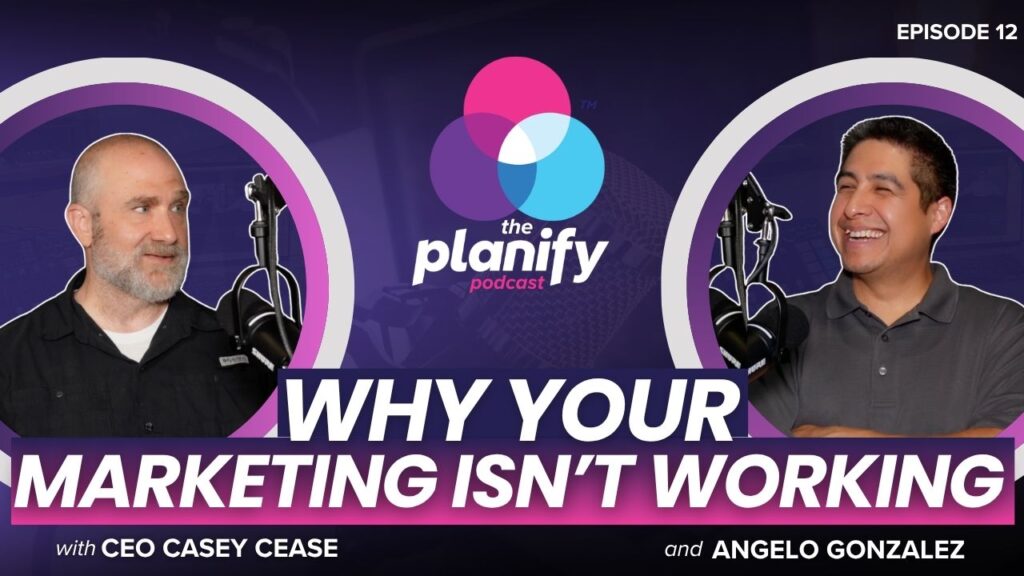
In this episode of the Planify Podcast, Angelo Gonzalez and Casey Cease walk through why local businesses should not copy national brand advertising, what a real local marketing strategy includes, and which levers move the needle fastest when your budget is finite.
Here is what you will learn: why brand-only advertising fails at the local level, the three low-cost foundations of local visibility, how to use reviews and referrals as growth systems rather than luck, when Google Local Service Ads make sense, and how to test a new offer before you spend anything on it.
Listen on your Favorite Platform
Why This Is Happening: The Root Cause Behind Scattered Local Marketing
The list of things you can spend marketing money on has never been longer. Print, direct mail, radio, movie theater pre-roll, sponsorships, apparel, business cards, paid search, social ads, connected TV. Every one of them works somewhere for someone. None of them work everywhere for everyone.
A national brand can afford to buy pure awareness. As Angelo points out in the episode, Coca-Cola can put a billboard on the freeway with nothing but a logo on it and that is a complete campaign, because the brand has spent more than a century building recognition. A plumbing company in Katy or Brenham cannot responsibly do the same thing. There is no budget to absorb a billboard that asks for nothing.
Here are the symptoms that show up most often:
- You are spending in several channels at once and cannot attribute revenue to any single one.
- You are still funding what worked five years ago because nobody has checked whether it still works.
- Growth has flattened after an early stretch that felt easy.
- When asked what your marketing strategy is, you describe tactics instead.
- You are considering spending more, but only because spending more feels like the next step.
Underneath all of those symptoms sits the same root cause: tactics were purchased before a strategy existed.
There is a second, quieter cause worth naming. Casey describes the vanity factor honestly. It feels good when someone at church or the grocery store says they saw you online. That is genuinely useful when the person lives in your service area. It is expensive when they live four towns over and will never buy from you.
There is also a timing issue that catches newer businesses. Casey notes that if you are from the area and have relationships, word of mouth can carry you through roughly the first 18 months. People are excited for you and want to support you. That reach has a ceiling, and when a business hits it, the instinct is usually to buy something rather than to plan something.
Where You Are Getting Stuck: Misconceptions That Waste Local Budget
“Marketing strategy is for big companies.”
When people hear the phrase marketing strategy, they picture national campaigns and corporate budgets. Casey makes the opposite case. Local businesses need strategy more, not less, because they have fewer dollars to waste. Strategy executed well pays out in both the short term and the long term.
“We do not spend much on marketing.”
This is one of the most common misreads in the episode. Casey describes a prospective client who said they had not invested much in marketing, then explained they spend six figures a year on conferences, association memberships, gifts to top clients, and happy hours at industry events. That is all marketing. Some businesses file it under business development. The label does not change what it is, and mislabeling it means it never gets measured.
“Old channels are dead.”
Angelo shares a story about a contractor friend who was still buying yellow pages placement. Angelo scoffed. The contractor tracked it, made more than he spent every year, and kept doing it. Casey adds that his own town still prints a phone book, and the names he sees advertising in it are companies that would not be there if it did not work. The point is not that print is good. The point is that channel decisions belong to your demographic and your data, not to a trend. A recommendation that fits a small Texas town may make you look foolish in Chicago.
“Local means we should spend less.”
Investment does not have to shrink because your market is small. Casey notes that plenty of local businesses doing a couple million a year spend meaningfully on marketing, and they can do that confidently because they have a strategy they can measure and can spot quickly when something stops producing.
“Asking for reviews or referrals is pushy.”
This belief costs more than any single ad channel. If someone paid you, was happy with the outcome, and knows other people with the same need, an invitation to share is not an imposition.
The Framework: Four Layers of a Local Marketing Strategy
Casey and Angelo lay out a practical order of operations. Start with the layers that cost time rather than money, then add paid channels once measurement is in place.
1. Fix your listings and information consistency
Local search rewards clarity. Your NAP details, meaning name, address, and phone number, should match across every place your business appears. That includes Google Business Profile, Yelp, Facebook, directory sites, and your chamber of commerce or trade association listings.
Casey’s caution is straightforward: algorithms get confused when the data does not match. Tracking numbers are the one reasonable exception, since they exist to attribute calls.
Practical steps:
- Search your business name and list every place it appears, including listings you did not create.
- Standardize one exact business name, one address format, and one primary number.
- Correct the easy platforms first, then work through the harder ones.
- Set up Google Alerts for your business name, common misspellings, and the owner’s name so mentions do not go unnoticed.
2. Treat reviews as reputation infrastructure
Reviews are increasingly decisive, and they are read more carefully than most owners assume. Casey reads the best and the worst reviews on any business he is evaluating. Angelo makes a related observation: people rarely go online to leave three stars, which is why a wall of average ratings reads worse than a mix that includes a few strong negatives handled well.
Build a repeatable process:
- Aim for genuinely good service first. A pattern of one-star experiences is an operations problem, not a marketing problem.
- Request reviews consistently after successful work, using automation rather than memory.
- Respond to every negative review publicly, briefly, and without defensiveness.
- Move the conversation offline, resolve what you can, and ask for a follow-up comment rather than demanding a rating change.
- Watch for repeat complaints and fix the underlying process.
Casey’s suggested response is short and specific: apologize, invite the person to call the office, and state clearly that you want to make it right. Angelo’s point is that most people reading reviews are reasonable. They do not expect perfection. They want evidence that you respond when something goes wrong.
3. Build a referral engine instead of hoping for referrals
Casey pushes back on the purist view that excellent work automatically produces referrals. It sometimes does. It produces far more when you build a path for it. His reasoning is practical: nobody is walking around thinking about lawn care or plumbing. It is not a topic until it is a problem.
A simple engine looks like this:
- Ask at the right moment. Not mid-project. After the outcome is delivered and feedback is positive.
- Collect the testimonial first, then invite the referral. Language like “we would love to work with more people like you” works because it is true and specific.
- Automate a follow-up in your CRM two or three months out that thanks the client, notes current services, and asks for a referral.
- Make the mechanism obvious. A main phone line, an email introduction path, or a QR code with a small incentive for the friend.
- Reuse the social proof. Casey suggests turning strong testimonials into simple graphics and running a few dollars a day of local awareness or retargeting on Meta.
4. Add paid channels you can measure, starting with Local Service Ads
When you search for a service provider now, organic results are several scrolls down. Above them sit AI summaries, the map pack, Google Local Service Ads, and standard search ads.
Local Service Ads are the units at the top with a verification badge, a call button, and a booking option. They differ from standard search ads in two ways that matter for a tight budget. First, service businesses that can prove licensing and liability insurance can qualify for the Google guarantee badge. Second, the billing model is lead-based rather than click-based, and Casey notes that calls outside your service area or unrelated to your service can often be disputed for a refund.
The realistic caveats from the episode: verification takes work, and support has historically been difficult to reach. Angelo describes it accurately as hoops. Casey’s recommendation is still to test it, because it is one of the cleaner entry points into paid local acquisition.
Implementation Tips and Examples
Run the honest spend audit first. List every dollar leaving the business for visibility, including conferences, sponsorships, apparel, gifts, and events. Put a tracking method next to each line. Anything without a tracking method is a candidate for either instrumentation or elimination.
Expect multi-touch behavior and plan for it. Casey describes a common pattern: a client runs engagement ads on Meta and their branded organic search volume rises, because people see the ad, do not act, then search the business name later. Angelo’s version of this is the customer who says only “I found you online.” Ask how people found you, accept that the answer will be incomplete, and use branded search volume as a supporting signal.
Do the math before you scale. Casey describes a local business where the return ran roughly five to ten times spend in strong months and around three times in slower ones. Three thousand dollars in, nine thousand out. He also flags the constraint that saves budgets: ads performing at one hundred dollars a day do not automatically perform the same at two hundred. Scale in increments and confirm the economics at each level.
Weigh acquisition cost against repeat value. In the same example, the deciding factor was that satisfied customers came back. A first job that barely breaks even can still be a good buy when the second and third jobs are profitable.
Test new offers on your existing list before launching anything. Casey calls this the freebie of the episode. When you add a service, the instinct is a new campaign. The cheaper first move is to contact people who already trust you, by email, text, or direct mail, and see whether the offer lands. Angelo adds the adjacent list: leads that nearly closed and stalled for reasons that had nothing to do with wanting the service.
Use gating language that stays within the rules. Rather than asking for five stars, Casey suggests including a line asking anyone who did not receive five-star service to contact you directly. That routes frustration to your team instead of your profile, and it only works if you actually respond.
Common Mistakes and How to Avoid Them
Buying tactics before defining strategy. The birdshot approach spreads budget thin enough that nothing produces a readable signal. Decide who your ideal client is, where they spend attention, and what offer speaks to them before you buy placement.
Freezing on what used to work. The opposite failure is analysis paralysis, which usually looks like continuing to fund a declining channel because it once performed. Casey’s framing is useful here: even if an older channel is still producing, you are limiting future growth if you are not tracking where the next wave of customers is coming from. A 28-year-old buying a first home needs home services for the first time and is not finding you the way your existing customers did.
Running paid ads without measurement discipline. If you cannot state your cost per lead, close rate, and average customer value, you are not measuring return. You are hoping.
Confusing marketing with sales in your internal language. Casey describes a client who kept saying sales when he meant marketing, and counted online ads as sales activity. Vague language leads to vague accountability. Be general in conversation if you must, but be specific about which strategy and which tactic you mean.
Dismissing feedback instead of investigating it. When a client says the leads are bad, Casey’s team asks for detail: follow-up process, sales sequence, tracking, whether the issue is a handful of leads or a consistent pattern. That diagnostic once surfaced a real platform-level problem, when a Meta ad algorithm change started sending a local advertiser calls from Vermont. Feedback is the input that finds the actual fault.
Treating a bad review as a permanent loss. Unanswered negative reviews do real damage. Answered ones frequently do the opposite.
FAQ: Local Marketing Strategy for Small Businesses
What is a local marketing strategy?
A local marketing strategy defines who your ideal customer is inside a specific geographic area, what you want them to believe about their problem and about your business, which channels reach them, and how you will measure results. Tactics like ads, listings, and sponsorships are how the strategy gets executed. Without the strategy, they are just expenses.
How much should a local business spend on marketing?
There is no single correct number, and the episode intentionally avoids one. The workable approach is to spend at a level where you can measure return, confirm that return, then increase in increments. Being local does not require spending less. It requires spending specifically and tracking closely.
How do you improve local SEO without a large budget?
Start with the levers that cost time instead of money. Make your name, address, and phone number consistent across every listing, keep your Google Business Profile complete and current, build a steady flow of reviews, respond to all of them, and monitor mentions with Google Alerts. These take effort to maintain and very little cash.
Are Google Local Service Ads worth it for small service businesses?
They are worth testing for most licensed and insured local service businesses, because you pay for leads rather than clicks and can dispute leads that are out of area or out of scope. Set expectations realistically. Verification requires documentation and patience, and support can be slow.
How should you respond to a one-star review?
Respond publicly, quickly, and briefly. Acknowledge the experience, avoid arguing the facts in public, and invite the person to contact your office directly. If you were at fault and they give you a chance to fix it, fix it and then ask whether they would be willing to leave a follow-up comment. There are situations, particularly public relations issues, where the better choice is not to engage point by point.
How do you ask for referrals without sounding pushy?
Ask after you have delivered a good outcome and collected positive feedback, not in the middle of the work. Frame it around fit rather than favor, then make the path easy with a phone number, an email introduction, or a shareable code. Automating a polite reminder a few months later keeps the ask consistent without making it awkward.
Should you launch a new campaign when you add a new service?
Usually not first. Promote the new service to past customers and stalled leads before you spend on new acquisition. It is inexpensive, it tells you quickly whether the offer resonates, and it converts trust you already earned.
Conclusion
Local marketing has not gotten more complicated. It has gotten noisier. The mediums change, the tactics change, and the underlying job stays the same: get in front of the right people nearby, tell them clearly what you understand about their problem, explain why you can solve it, and invite them to act.
The order matters. Define the strategy. Fix your listings. Build a review and referral system that runs whether or not you remember to run it. Then add paid channels you can measure, and scale only what proves out.
Pick one thing this week. Audit your listings for consistency, or write the response you have been avoiding on a negative review, or send one offer to customers who bought from you three years ago. Then do the next one.
Ready to Get Strategic About Your Local Marketing?
If you are spending on marketing but cannot say which part is working, we are glad to take a look. Book a strategy call with the Planify team and we will review where your budget is going, how it is being tracked, and which local levers are most likely to move revenue in your market.
Visit planify.agency to get started.
One More Thing
If this episode was useful, share it with a local business owner who is spending without tracking. Leave a five-star review on Apple Podcasts or Spotify, subscribe on YouTube at @planify.agency, and tag us on Instagram at @planifyagencywhen you share. It helps us reach more owners building something durable.