
If your team keeps missing goals, repeating the same mistakes, or quietly pulling back, the problem is rarely effort. More often, the environment around the work is working against the people doing it. Unwritten expectations, feedback that only shows up when something goes wrong, and a lack of direction can leave capable people guessing. Adding new software on top of that tends to add noise, not progress.
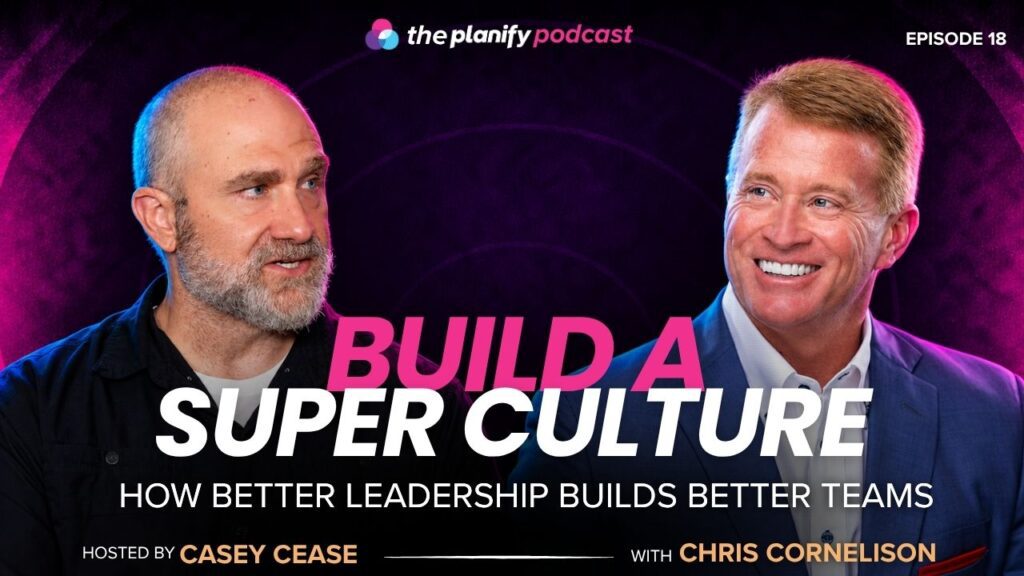
This post is for business owners, department leaders, and family business successors who want a steadier, more productive team. It draws on The Planify Podcast conversation between Casey Cease and Chris Cornelison, a pharmacist turned culture coach, author of Super Culture, and CEO of Solutions Rx. Chris owned three independent pharmacies, sold them in 2020, learned culture lessons the hard way, and now coaches leaders on praise, vision, and written processes.
You will learn why praise changes how people respond at work, how to build a one-year vision your team can use, and how to apply AI workflows so they strengthen your culture instead of replacing the human parts that matter.
Why This Is Happening: Symptoms and Root Causes of a Weak Team Culture
Culture problems usually show up as practical frustrations before anyone calls them a culture problem. You may recognize some of these:
- Goals get missed and nobody is sure why.
- The same issues repeat month after month.
- Team members go quiet in meetings, or they leave sooner than you expected.
- You are the only person who knows how things are supposed to work.
Chris lived through all four. Seven months into owning his family’s pharmacy, he had an empty bank account, a roughly $50,000 drug bill due in three days, and a habit of kicking a trash can when he got frustrated. He still keeps that trash can as a reminder. That night, looking at the mess he had made, he asked himself whether the bank account was empty partly because the person running the company was acting like a jerk.
Root cause 1: Leader reactions set the environment. Chris admired the coaches he played for in college, and he assumed yelling was how leaders got results. He did not realize how much it was shutting his team down. According to Harvard Health, the amygdala processes emotion and sends a distress signal to the hypothalamus when it perceives danger, which starts the fight-or-flight response. Chris’s practical takeaway is that a person who feels disrespected may stop hearing what you say next. Casey added that the brain eventually decides whether a threat is real. If it decides the threat is not real, people start ignoring you. If it decides the threat is real, they may fight back or leave.
Root cause 2: The room becomes the trigger. Chris described leaders who only call people into their office to correct them. Over time, walking through that door can put an employee’s guard up before a word is spoken, even when the conversation turns into helpful coaching. It works like being called to the principal’s office as a kid.
Root cause 3: Nothing is written down. Without written goals and processes, a team has no shared direction and no easy way to get on the same page.
Root cause 4: Recognition is thin. A Gallup recognition guide reports that in the typical workgroup Gallup has studied, about one in four employees strongly agree they received recognition for good work in the past seven days. The same guide reports that employees who are not adequately recognized are twice as likely to say they will quit within a year. Recognition is also built into the Gallup Q12 engagement survey.
Where You Are Getting Stuck: Misconceptions and Bottlenecks
Even motivated leaders can stall because of a few common beliefs.
- “Tough feedback gets results.” Context and frequency matter. Casey noted that his father’s military-shaped style came from a specific environment, and that adaptive leaders consider each person’s role and life context. Correction has a place, but it works better inside a relationship that also includes recognition.
- “Praise is a nice extra.” Chris’s mantra is to praise what you want repeated. He explains that dopamine rises with praise but fades quickly, which he compares to a shot of liquor. In a relaxed, low-threat environment, he says acetylcholine follows, which he links to learning, memory, and habit formation. That is the moment he considers best for coaching new processes. Treat this as a leader’s working framework, not a clinical claim. Brain chemistry is complex, and you do not need to be a neuroscientist to apply the habit.
- “A vision has to be 20 years long.” Chris’s coach had him write a 20-year vision. Today he thinks five years is about as far out as many leaders can write in a fast-moving market, and he coaches clients to build a one-year vision first.
- “We need to pick the right AI tool.” Casey sees many owners start with tools. He describes many industry tools as wrappers around a language model with industry wording added. His recommendation is to map how your business works first, then decide where AI fits, because tools change quickly.
- “We will tolerate it for now.” When Chris kept raising the same issue with his coach, the coach asked a fair question: if you are going to tolerate it, why keep talking about it?
A Five-Step Framework for Culture, Vision, and AI
Step 1: Write it down
Chris’s second rule in Super Culture is “write it down or it does not exist.” Start by auditing three things: whether your company goals are written and visible, whether your processes are documented, and whether your team can describe both. If processes or goals are missing, that is your starting point.
Step 2: Build a one-year vision
Write a one-year vision that covers profit, improvements, and friction you want to remove. Chris coaches clients to pull this out of their heads quickly and in their own words. Ownership matters here. Casey put it well: a coach cannot want the outcome more than the leader does.
Step 3: Use “on vision or off vision” as a filter
When a new idea, hire, or tool comes up, ask whether it is on vision or off vision. Chris says clients often answer the question themselves before he has to. Review the vision quarterly and choose three goals that fit it.
Step 4: Praise what you want repeated
Be specific. Name the behavior you want to see again, and say it close to when it happens. Make sure your office or meeting room is sometimes the place where good news happens, so it does not become only a place for correction.
Step 5: Coach it, change it, or tolerate it
Chris gives leaders three options for any recurring problem. Coach it first. If coaching does not work, change it, which can include recognizing that a good person is a poor fit for the culture you are building. Or consciously tolerate it, but do not drift into tolerating by default.
Implementation Tips and Examples
Scenario 1: The correction-only office
A pharmacy manager notices that staff tense up when called into the back office. For two weeks, she tracks how often she praises and how often she corrects. She then adds one specific, in-person recognition per shift and keeps corrections short and private. The goal is a balanced environment where coaching is easier to hear.
Scenario 2: A training follow-up workflow
Chris shared a live example he built with Casey’s team. His company wanted every new customer to receive product training. Here is how the workflow runs:
- An admin adds a new customer to the CRM, HubSpot.
- AI drafts the training invitation email and sends it.
- After the customer says yes, the workflow pauses so a human can deliver the training.
- When the trainer ends the Zoom call, that action triggers the next AI steps.
- The workflow logs notes in HubSpot, waits 30 days, then checks whether the customer is stable, growing, or shrinking.
- It drafts a different follow-up depending on the result, such as suggesting the next class for a growing customer.
- It also prompts a handwritten thank-you note, which the team writes and the sales rep signs.
Chris pointed to a culture benefit. His admin had been stretched thin, and training sign-ups were slipping. With the repetitive work handled, she had time to design a quick-read insert with QR codes for product boxes. The workflow keeps humans at the points where relationships are built. Chris was clear that these results are early, and he expects training and sales to rise but had not yet measured the effect.
Scenario 3: Evaluating AI vendors
A business owner Chris met had three quotes for AI builds at around $600 per month each. Chris coached him to start with the friction he wants to solve or the result he wants to grow, then bring that to each vendor. The point is not to avoid vendors. It is to understand what you need so you can judge whether a generic build fits.
Scenario 4: Preparing a successor in a family business
Chris did not want to sell his grandfather’s original pharmacy to a large chain. He told a longtime employee, Lee Griffin, that the timeline could be shorter than five years, opened the books, and mentored him through the process. An SBA program available during COVID also helped the timing. If you are planning a handoff, note that a widely cited estimate says about 30% of family businesses make it through the second generation, with lower numbers for later generations. The Family Business Consulting Group cautions against reading those numbers as pure failure, since some businesses are sold or merged by choice. Planning early gives you more choices either way.
Three ways to approach AI
Chris and Casey described three paths in their upcoming class at AI Tools That Work: do it yourself with a clear walkthrough, do it with guidance, or have a team build it for you. Casey is clear on the principle behind it: AI exists to enhance human performance, not replace it.
Common Mistakes and How to Avoid Them
- Starting with tools instead of friction. List where work gets stuck first, then match tools to those points.
- Automating the human moments. Keep a person in the loop for training, thank-you notes, and anything relationship-based.
- Praise that is vague. “Good job” fades quickly. Name the behavior you want repeated.
- Using the leader’s office only for correction. Add recognition, goal reviews, and good news to that space.
- Skipping the written vision. A verbal vision is hard for a team to follow and easy for a leader to change without noticing.
- Tolerating a recurring issue by default. Choose to coach, change, or tolerate, and say which one you chose.
- Expecting instant results. Culture and workflow changes take time, and early signals are not the same as measured outcomes.
Frequently Asked Questions
What does “praise what you want repeated” mean?
It means recognizing specific behaviors you want to see again, soon after they happen, so the team knows what good looks like.
Does praise really change team behavior?
Research from Gallup links recognition with higher engagement and lower intent to quit, though results vary by workplace. Praise works best when it feels authentic and specific.
How long should a company vision be?
Chris suggests starting with a one-year vision and extending further out as you build confidence. He considers five years about as far as many leaders can reasonably plan in today’s market.
How do I decide whether to coach, change, or tolerate a problem?
Start with coaching. If the issue persists after clear coaching, consider whether the role or fit needs to change. If you choose to tolerate it, make that a deliberate decision with a time limit.
Where should a small business start with AI?
Start with the workflow, not the tool. Find a repeated task that causes friction, decide where a human should stay involved, and then test AI on that one process.
Will AI replace my team?
Casey’s view is that AI should enhance human performance. Some consistent, repeatable tasks can be handled by AI, but relationship-driven work still benefits from people.
Conclusion
A strong company culture comes from a few repeatable habits: write down your goals and processes, build a one-year vision your team can use, praise the behaviors you want to see again, and make deliberate choices about problems. AI workflows can support those habits by clearing repetitive work and giving people time for the human parts of the job. Start small. Pick one friction point this week, decide who stays involved, and write the vision that tells you whether the change is on track.
Ready for a Clearer Plan?
Get your custom Business Growth Strategy Blueprint: https://planify.agency