
Most business owners do not have a content problem. They have a content system problem. They record a few videos, write a couple of posts, feel good about it for a week or two, then either run out of ideas or run out of time. The content disappears from the feed, the views were low anyway, and the whole thing quietly stops.
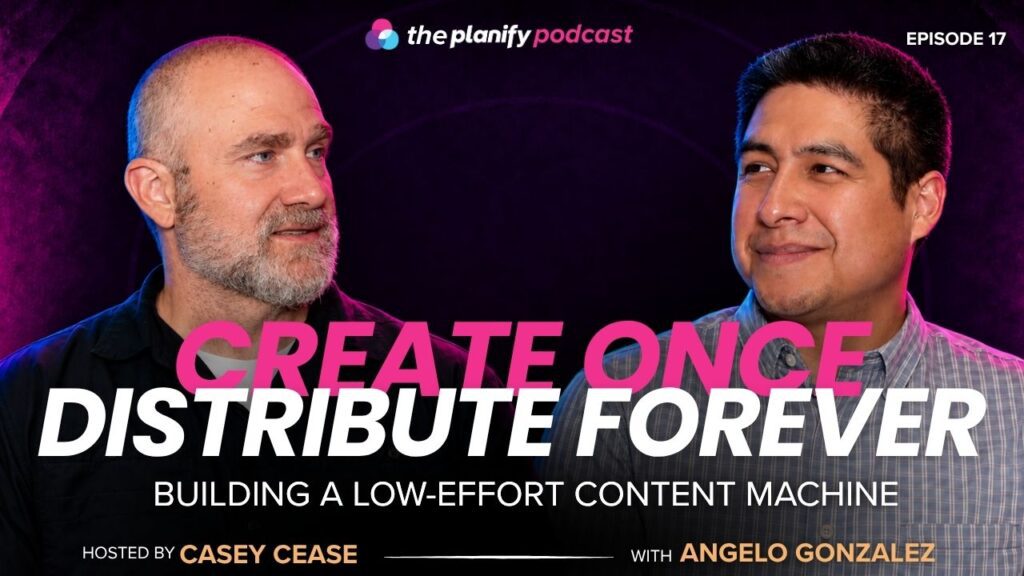
This post is for the owner who has started and stopped content more than once, who assumes marketing online means becoming a TikTok personality, or who simply does not know what to talk about next. In this episode of the Planify Podcast, Angelo Gonzalez and Casey Cease walk through why content creation feels scary for so many business owners and lay out the exact process Planify uses internally, and with clients, to turn one recorded conversation into weeks of blog posts, video clips, newsletters, and podcast episodes.
Here is what you will learn: why the content treadmill burns people out, the misconception that keeps most owners stuck at “I don’t know what to post,” a step by step framework for turning one recording into many assets, and where AI actually belongs in that process without turning into what Angelo calls AI slop.
Listen on your favorite platform
Why This Is Happening: The Content Treadmill Problem
Content creation has a predictable failure pattern, and it is not really about discipline.
Angelo describes it directly in the episode: a business owner gets excited, buys a tripod or a microphone, and starts posting. The first few weeks are fun. Then one of two things happens. Either they run out of ideas, or they run out of time. A third failure mode shows up even when the first two do not: they post something they are genuinely proud of, it gets five views and no likes, and they quietly stop trying.
None of that means the business owner is bad at marketing. It means there was no system behind the content, only motivation, and motivation is a finite resource.
There is a second layer underneath the burnout. Many owners equate “content creation” with performing. They picture a TikTok dance, a movie-star level of comfort on camera, or a level of polish they associate with influencers rather than experts. Angelo’s counterpoint is straightforward: business owners are almost always the expert in their own work, and people who talk about what they know and care about are naturally watchable. The discomfort is not really about the camera. It is about not having been asked the right questions yet.
Casey’s own experience backs this up. Before starting the Planify Podcast, he had tried a produced show with an outside agency and it stalled, because he was still doing too much of the production himself between recordings. His condition for trying again was simple: he would show up, talk, and leave. Everything else, from editing to distribution, had to be handled by a system, not by him.
Where You Are Getting Stuck: Misconceptions That Keep the Treadmill Spinning
“I need to be entertaining to post content.”
Casey is blunt about this in the episode: a shingle is a shingle is a shingle. What builds trust is not charisma, it is usefulness. A roofer who explains why a certain underlayment matters, or a personal injury attorney who explains what to do in the first hour after an accident, builds more trust than someone claiming to be “the most awesome” version of their category. You do not need to be a performer. You need to be useful on camera the same way you are useful in person.
“One piece of content is one post.”
This is the most expensive misconception in the episode. Most owners record a video, post it once, and consider the job done. Planify’s approach treats a single recording as raw material for a blog post, a podcast episode, several social clips, a newsletter, and outbound links to guests and resources. A 2023 Semrush survey found that 42 percent of marketers credit updating and repurposing existing content as a factor in their content marketing success, which lines up with what Angelo describes: the content itself is rarely the bottleneck. The distribution plan is.
“AI will write it, so I don’t need to check it.”
Angelo is direct about the difference between using AI and outsourcing judgment to it. Dropping a topic into a prompt and publishing whatever comes back is what he calls AI slop. What Planify does instead is drop in the actual transcript, give the AI a detailed prompt built from real research on what “optimized” means for that platform, and then edit the draft using their own knowledge of what was actually said. The AI drafts. The human with the expertise decides.
“Once we’re bigger, we’ll just hire someone full time.”
Casey flags this as a common and costly step for businesses somewhere in the one to five million dollar range. A full-time content hire needs a steady stream of direction and ideas to stay productive, and many businesses at that size cannot generate enough direction to keep one person fully occupied. The result is a frustrated hire and a frustrated owner. The fix is not always more headcount. It is often a better system for capturing and multiplying the content the business already generates.
The Framework: Building a Content Factory From One Recording
Casey and Angelo describe a repeatable process. Here is the order it runs in.
1. Build a topic wheel so you never run out of ideas.
Instead of one general subject, Planify helps clients map out a wheel of related topics and angles. Angelo’s example is a roofing client: roofing itself is one spoke, but insurance claims, storm damage, HOA rules, and different roofing materials are all separate spokes with their own sub-topics. By the time you cycle back to your first topic, months have passed and you can revisit it from a new angle. This is a research task, not a creativity task, and it is the single biggest reason people stall out on ideas.
2. Capture one piece of source content.
This is usually a recorded conversation: a podcast episode, an interview, or even a phone-selfie video. The owner’s job is to show up prepared and talk, the same way Casey shows up to the studio already briefed on the discussion. For Casey, that is roughly two to three hours a week across all the episodes he records. For a smaller business, it can be a single one-hour interview a month.
3. Turn the recording into a transcript first.
Angelo is specific that this is the step that unlocks everything else. Most podcast hosting platforms will generate a transcript automatically. Once you have text instead of only audio or video, you can generate a blog post, pull quotes, build an optimized title and description, and identify clips worth cutting for social media, all from the same source.
4. Use AI to draft, not to replace, your expertise.
With the transcript in hand, Planify prompts an AI tool with specific instructions built from their own research on what makes a title or description “optimized” for a given platform, asks for a full draft, and then edits based on firsthand knowledge of the conversation. The output is roughly 90 percent there on the first pass. The editing is what keeps it accurate and on-brand.
5. Distribute the same asset across every channel that fits.
From one recording, Planify typically produces: a blog post, an optimized podcast title and description for Apple Podcasts and Spotify, a YouTube upload with its own optimized title, several short clips or Reels cut by a social media manager, an email newsletter built around the blog, and outbound links to any guest’s website and social profiles. Each channel reaches a different segment of the same audience, since some people read, some listen, and some only watch short video.
6. Track performance and reinvest in what works.
Casey’s team watches which clips perform best organically, then puts a modest ad budget behind those specific pieces. This does double duty: it extends the reach of proven content, and it generates real data on what the audience actually wants to hear about next, which feeds back into step one.
Implementation Tips and Examples
Treat equipment as an investment, not overhead. Casey was explicit about how he justified buying cameras and microphones for the Planify studio: it is a one-time cost against content that will be used repeatedly, for the business itself and eventually for clients. If a piece of equipment is not tied to a content plan, it is easy to end up with what Casey admits having, a closet full of unused DSLR cameras bought “to start something” that never got a system behind it.
Give the owner a narrow, well-prepped role. Casey’s requirement for the podcast was that he show up, get asked good questions, and leave. The team preps the discussion in advance and handles everything downstream. If you are the expert in your business, this is the role that keeps content sustainable: talk about what you know, and let a system carry the rest.
One interview a month can carry a small business’s content calendar. Planify has a client, a business owner who does not want to run a podcast or be on camera regularly, who agrees to an hour-long interview once a month. From that hour, the team builds roughly a month of articles, SEO pieces, strategy content, short clips, and even ad creative, since the ad copy comes directly from what the client already said rather than being written from scratch.
Let a personal injury attorney example show you the stakes. One Planify client is a personal injury attorney who records content on real, practical questions people have after an accident. Nobody wants to need that information. But if the content already exists when the moment happens, the person searching remembers the name and the face, not just a generic ad. That single recording session gets reused across multiple pieces of content over time.
Interview adjacent, non-competing businesses. Angelo suggests featuring other local businesses, such as a roofer interviewing an insurance agent or a landscaper, as part of the topic wheel. When you mention or tag another business, they often reshare it, which puts your content in front of their audience and creates the kind of cross-linking activity that search engines read as a signal of legitimacy.
Common Mistakes and How to Avoid Them
Skipping the transcript step. Trying to manually rewrite a video into a blog post, a caption, and a newsletter from scratch, three separate times, is what causes people to run out of time. Generate the transcript first and work from text.
Publishing AI output unedited. This is the fastest way to produce generic, forgettable content. The transcript and the prompt should come from a real conversation and real expertise, and a human who understands the business should always review the draft before it goes out.
Buying gear before building a process. Good equipment does not create content discipline. A clear plan for what to record, how often, and where it goes afterward does. Decide the process first, then buy only what the process requires.
Hiring a full-time content creator too early. If a business cannot generate enough direction and raw material to keep one person busy, a full-time hire usually ends up frustrated and underused. A better first step is often to build a repeatable capture and repurposing system, whether in-house or with outside support, before adding headcount.
Treating content as a vanity metric. Low views on an early post do not mean the strategy failed. According to Google’s own guidance on search quality, search systems evaluate experience, expertise, authoritativeness, and trustworthiness, sometimes called E-E-A-T, when judging content quality. Consistent, accurate content across your website, social profiles, and other listings builds those signals over months, not overnight.
Doing everything solo indefinitely. Angelo’s team tracks the entire process in a task management tool, ClickUp, though a shared spreadsheet works too if that is what a smaller business has. The tool matters less than having a defined, written process that more than one person can execute.
FAQ: Content Repurposing Strategy for Business Owners
What is a content repurposing strategy?
A content repurposing strategy is a process for turning one piece of source content, usually a recorded conversation or interview, into multiple formats and channels: a blog post, social clips, a podcast episode, a newsletter, and more. Instead of creating separate content for each channel, you create once and adapt it many times.
How do I know what to talk about if I run out of ideas?
Build a topic wheel before you start recording. Take your core subject and break it into related spokes, such as common questions, misconceptions, seasonal issues, or adjacent services. A well-built topic wheel can supply months of material before you need to revisit a topic.
Can AI actually write my content for me?
AI can draft content efficiently when it is given a real transcript and a specific, well-researched prompt. It should not be trusted to write from a bare topic with no source material and no review, since that produces generic content that a knowledgeable reader can usually spot.
How much time does this actually take each month?
For Casey, recording several podcast episodes takes roughly two to three hours a week, including light prep. For a smaller business using the one-interview-a-month model, the owner’s time commitment can be closer to one hour a month, with the repurposing work handled separately.
When should I hire a dedicated content person instead of repurposing?
Consider a full-time hire once your business can consistently generate enough ideas, guests, and direction to keep that person productive. Many businesses reach this later than they expect. Building a repurposing system first, whether in-house or outsourced, is often a more efficient step.
Does content creation really affect local SEO?
Yes. Search engines look for consistent signals of expertise and legitimacy across a business’s website, social profiles, video platforms, and listings such as a Chamber of Commerce page. Regular, accurate content across multiple channels supports those signals over time.
Do I need expensive equipment to start?
No. Both Angelo and Casey point out that a phone can capture perfectly usable source content, especially at the start. Equipment becomes a reasonable investment once you have a process that will actually use it repeatedly.
Conclusion
Content creation feels scary because most people attempt it without a system, so it depends entirely on motivation, and motivation runs out. The fix is not more willpower. It is a repeatable process: build a topic wheel so ideas do not run dry, capture one solid piece of source content, transcribe it, use AI to draft while a knowledgeable human edits, and distribute the result across every channel your audience actually uses.
Pick one step this week. Write down ten topics for your own topic wheel, or record one honest, unscripted answer to a question you get asked often, on your phone, and see what you can build from it.
Ready to Build Your Content Factory?
If you know you are the expert in your business but do not know how to turn that expertise into consistent content, we can help you build the system, or run it for you. Book a call with the Planify team and we will walk through what a content factory could look like for your business.
Visit planify.agency to get started.
One More Thing
If this episode was useful, share it with a business owner who keeps starting and stopping their content. Leave a five-star review on Apple Podcasts or Spotify, subscribe on YouTube at @planify.agency, and follow along on Instagram at @planifyagency.