
If you have grown a business past its first few years, you already know the pattern. Revenue climbs steadily for a while, then flattens. You respond by hiring, leasing more space, buying more equipment, or spending more on ads. Growth ticks back up a little, then flattens again. Each step forward costs more than the last one did.
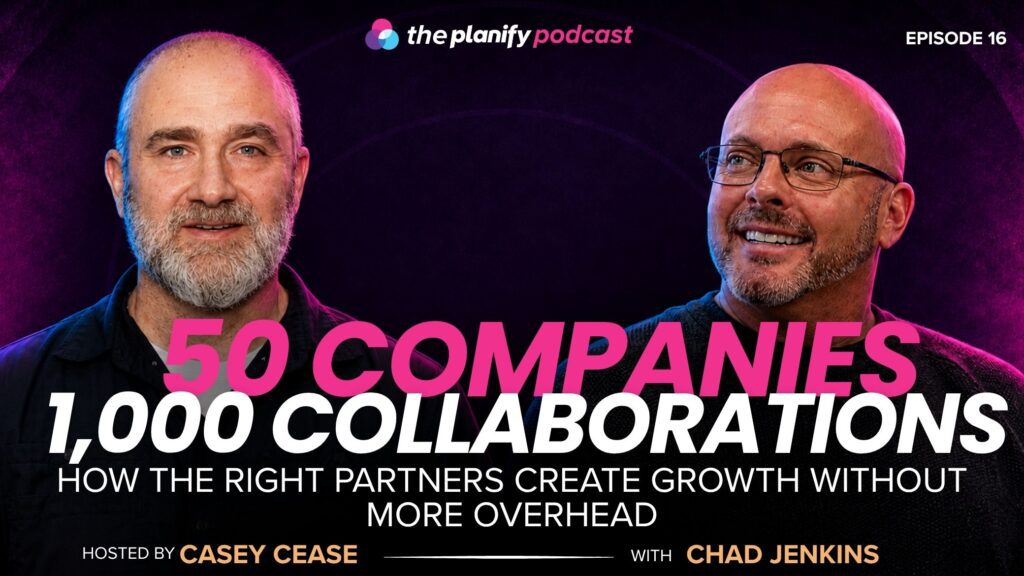
This post is for business owners and operators who feel that pattern in their bones, and who suspect there has to be a faster, less risky way to grow. It is based on a conversation between Casey Cease and Chad Jenkins, founder of SEEDSPARK and creator of the SEEDSPARK CoLAB community, on the Planify Podcast. Chad built more than 50 companies over 25 years using conventional growth methods before shifting entirely to a collaboration-based model that has produced more than a thousand partnerships in just over two years. Here is what you will learn: why linear growth stalls in the first place, the misconceptions that keep business owners stuck doing everything themselves, a practical framework for splitting revenue fairly in a partnership, and where this approach tends to go wrong.
Listen on Spotify | Apple Podcasts
Why This Is Happening: The Root Cause Behind Slow, Expensive Growth
Most businesses are built the same way. Someone has an idea, forms it into a plan, and then starts adding resources: employees, office space, trucks, software, ad spend. Each addition increases revenue a little, but it also increases fixed cost, payroll tax, insurance, and management complexity. Chad describes this as growing “linearly,” meaning up and to the right in small, predictable steps rather than in the large, non-linear jumps that outside observers call a hockey stick.
There are a few reasons this linear pattern is so common.
First, most industries run on what Chad calls conventional best practices, and he argues that best practices are simply the upper end of average. Everyone in an industry copies everyone else, so the entire industry converges on the same tactics, the same pricing logic, and the same growth ceiling. He compares this to the plastic film manufacturers leave on a new phone screen or television. Once you notice it is there and remove it, the picture underneath looks completely different. Most businesses never remove the film. They keep operating with someone else’s assumptions layered over their own potential.
Second, entrepreneurs are trained to believe value has to be acquired. Chad traces this back to a story from his childhood: his mother could only afford an off-brand pair of shoes when he wanted a specific pair, and that experience taught him early that he would have to build what he wanted from what he already had, rather than assuming it existed somewhere else waiting to be bought. Most business owners never test that assumption. They default to buying capacity (hiring, leasing, borrowing) instead of asking what capability already exists, inside their own network, that could be combined with what they have.
Third, growth by addition creates real risk that growth by combination does not. More employees means more payroll tax exposure. More office space means a longer lease commitment. More debt means a bigger bill regardless of whether revenue holds. Chad’s pivot toward collaboration was driven partly by recognizing that he had already paid, in decades of risk, for the assets and relationships he now had access to. Deploying those assets through partnership did not require taking on new risk.
Where You Are Getting Stuck: Common Misconceptions About Collaboration
“Collaboration means a joint venture, and joint ventures mean lawyers.”
The conventional version of a business partnership usually starts with forming a new legal entity, adjusting operating agreements, and buying key-man insurance before anyone has proven the idea works. Chad’s approach reverses the order. He starts with a one-page document that identifies who each party serves, what part of the value creation each person already brings, and how the value will be split. Legal structure comes after the collaboration has proven itself, not before.
“I need to bring something impressive to the table.”
Business owners often introduce themselves with a title (attorney, consultant, contractor) rather than describing the actual capability behind that title. Chad’s method for evaluating a potential collaborator is to ask “tell me more” until the person’s real, transferable capability surfaces. In one example from the episode, a man who ran college campus productions turned out to have deep, non-legal expertise in identifying intellectual property value inside small businesses, something almost none of his own clients realized he could do until Chad asked.
“If I don’t like the split, I have to negotiate harder.”
A core principle in Chad’s model, borrowed in part from Strategic Coach founder Dan Sullivan, is that you should always be able to walk away. If a proposed split does not work for either party, the deal simply does not happen. No lawyers were paid, no meetings were wasted, and nobody is stuck. This only works if you already have what you need before the deal, so you are negotiating from strength rather than need.
“Bigger, more established partners have all the leverage.”
The episode’s investment banker example makes the opposite case. The most experienced, highest-integrity partner in that story did not bring more leverage because of size. He brought leverage because his approach was different from every other investment banker chasing the same EBITDA multiple. Differentiation, not size, created the advantage.
The Framework: The VCR Formula for Fair, Fast Collaboration
Chad’s system starts with a three-step process he calls collect, combine, and create, and it culminates in a revenue-split framework called the VCR Formula, developed in partnership with marketing strategist Dean Jackson. Here is how to apply it.
Step 1: Collect the exploded parts view.
Before you evaluate a potential collaborator, get past their title. Ask what they actually do, how they do it, and what unclaimed capability sits underneath the label. The goal is to find a specific, transferable skill or asset, not a general profession.
Step 2: Identify your Vision, Capability, and Reach.
Every business, and every potential partner, brings some combination of three things. Vision is the original idea and the willingness to carry the risk of it. Capability is the operational ability to execute, whether that is a team, a process, equipment, or specialized expertise. Reach is the ability to get the offer in front of the right people, whether through an audience, a client list, or a referral network. Map yourself and your potential partner against these three categories honestly before assuming what role you should play.
Step 3: Combine, and let the split follow the value.
Chad tested this framework against the profit and loss statements of his own companies across industries from construction to private real estate funds and found a consistent pattern. Vision tends to command 10 to 20 percent of revenue. Capability tends to command 60 to 80 percent. Reach tends to command 10 to 20 percent. These are not arbitrary; they reflect what each function typically nets after its associated costs and risk. Use these ranges as a starting point for negotiating a fair split rather than starting from scratch every time.
Step 4: Create the emergent outcome, then decide on structure.
The formal collaboration agreement, the named entity, or the branded joint offer is the output of a good combination, not the starting point. Write the one-page agreement once both sides understand what they are contributing and what they will receive. Add legal structure only once the collaboration is proving out.
Implementation Tips and Examples
Ask “tell me more” before you evaluate anyone’s fit. In the episode, this single follow-up question uncovered a collaborator’s intellectual property expertise that his own title gave no hint of. Practice asking it in your next three networking conversations and note what surfaces.
Look for partners solving the same problem from a different angle. The investment banker in Chad’s example already worked with sellers 2 to 10 years before a transaction. The IP specialist already worked with the same type of client on a completely different problem. Neither changed what they did. They combined their existing offers into a joint onboarding process that created a new competitive advantage for both.
Test the VCR split against your own P&L. Pull a recent profit and loss statement and map your revenue against vision, capability, and reach the way Chad did. If your numbers land outside the 10 to 20 / 60 to 80 / 10 to 20 pattern, it is worth asking why, since one function may be underpaid or overpaid relative to the value it is actually creating.
Look outside your own network for reach partners. Chad’s realization, prompted by managing 26 companies at once, was that somewhere on the planet there is likely another entrepreneur who already has a relationship with every client you would ever want. Kylie Jenner’s cosmetics line is a widely cited example of this principle in action. She had the idea and an enormous audience, and partnered with Seed Beauty, an existing cosmetics manufacturer, to supply the capability she did not have. The lip kit line reportedly generated hundreds of millions of dollars within its first two years, and Kylie Cosmetics has since become a case study in what fast collaboration between vision and capability can produce.
Consider what a name-brand collaboration signals to a market. Nike’s collaboration with Tiffany & Co. on a limited sneaker release combined two brands that had done nothing differently the day before the deal, but the combination created cultural and commercial attention that neither could have generated alone. It is a useful reminder that a collaboration does not always require a new product; sometimes it requires a new combination of existing credibility.
Common Mistakes and How to Avoid Them
Adding red tape before testing the idea. Forming an entity, hiring lawyers, and negotiating insurance before proving a collaboration works slows everything down and raises the cost of walking away if it does not work. Test with a one-page agreement first.
Confusing collaboration with doing something new. The magic in Chad’s model is combination, not reinvention. If a proposed partnership requires either side to build a brand-new capability from scratch, it is closer to a traditional joint venture than the fast, low-risk model described here.
Skipping the honest self-assessment. It is tempting to assume you bring vision when you actually bring capability, or to overvalue your reach when it is really quite narrow. Map yourself against the VCR categories honestly, ideally using real revenue data, before proposing a split.
Letting ego drive the negotiation. Chad is direct about this: after building and selling more than 50 companies, he is comfortable taking a smaller, fair percentage and letting a partner run point, because the size of his share matters less than whether the collaboration produces reliable value. A split that feels unfair because of pride rather than math is usually a signal to renegotiate the structure, not the ego.
Assuming everyone wants to be a “yes” fit. Not every business owner is ready for this model. Chad is candid that some entrepreneurs are well served by their current operating businesses and do not need to change anything. Collaboration works best for people who already sense there is more available to them and are tired of linear, all-consuming growth.
Frequently Asked Questions
What is the VCR Formula?
The VCR Formula is a framework, developed by Chad Jenkins in collaboration with marketing strategist Dean Jackson, for splitting revenue in a business collaboration based on three contributions: Vision (the idea and risk), Capability (the execution), and Reach (the audience or client access). Typical splits run 10 to 20 percent for vision, 60 to 80 percent for capability, and 10 to 20 percent for reach.
How is a business collaboration different from a joint venture?
A traditional joint venture usually starts with forming a legal entity and negotiating terms before the idea is tested. A collaboration, as described in this episode, starts with a simple one-page agreement outlining who serves whom and how value will be split, and adds formal structure only after the idea proves out.
Do I need to form an LLC to start a business collaboration?
Not at the outset. The model described here intentionally delays legal structure until the collaboration has demonstrated value, which reduces upfront cost and risk for both parties.
How do I find the right collaboration partner?
Ask “tell me more” past someone’s job title to uncover a specific, transferable capability. Look for people solving a related problem from a different angle rather than people who do exactly what you do.
What if I don’t have anything unique to bring to a collaboration?
Chad’s core argument is that every business owner already has enough vision, capability, or reach to combine with someone else’s; the work is identifying and being honest about which of the three you actually bring, rather than assuming you need to acquire something new first.
Is this approach right for every business owner?
No. It tends to fit entrepreneurs who already sense they are capable of more and are tired of growing only through added risk and overhead. Business owners who are satisfied with their current growth rate and structure may not need to change anything.
Where can I learn more about this framework?
Chad Jenkins outlines the full model in his book, The Code to Collaboration, and through the SEEDSPARK CoLAB community, both linked in the resources section of this post.
Conclusion
Growth does not have to mean adding more risk, more overhead, and more hours. Chad Jenkins’ shift from building 50-plus companies to building more than a thousand collaborations in two years suggests that the faster path to growth is often already available inside your existing network, once you know how to identify and combine it. The VCR Formula gives you a concrete way to evaluate what you bring to a partnership and negotiate a fair split before you spend a dollar on legal structure.
Pick one relationship this week where you sense a fit but have not explored it. Ask “tell me more” past the title, map the conversation against vision, capability, and reach, and see what a one-page agreement might look like before you assume you need anything more formal than that.
Ready to Build Growth Through Collaboration Instead of More Overhead?
If you are trying to figure out whether a partnership, referral relationship, or joint offer could grow your business faster than another hire or another ad campaign, we are glad to help you think it through. Book a strategy call with the Planify team and we will look at your current growth plan and where a collaboration-based approach might fit.
Visit planify.agency to get started.
One More Thing
If this episode was useful, share it with a fellow entrepreneur who is trying to grow everything alone. Leave a five-star review on Apple Podcasts or Spotify, subscribe on YouTube at @planify.agency, and tag us on Instagram at @planifyagency when you share. It helps us reach more owners building something durable.