
Most small business owners think of marketing as something you buy. A logo package, a run of ads, a few months of social media posts. When cash is tight, that’s usually the first budget line to shrink, and referrals get treated like luck rather than something you can actually build on purpose.
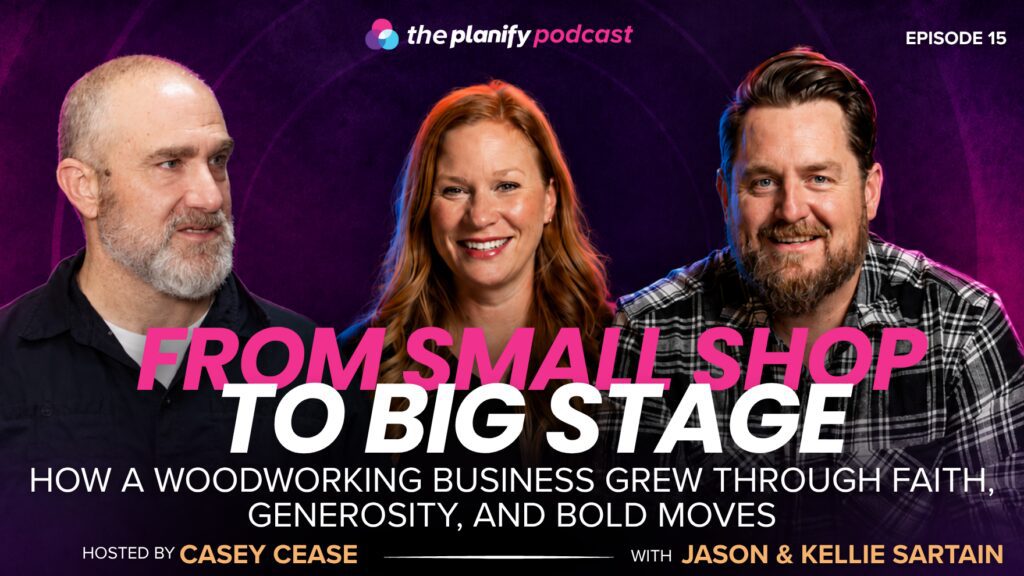
This post is for owners of local service or maker businesses who have more skill than marketing budget, and who have wondered whether giving something away for free is smart strategy or just a good way to lose money. It uses the story of Sartain’s Awesome Shoppe, a custom woodworking company in Bellville, Texas, as told on the Planify Podcast by owners Jason and Kellie Sartain.
Their business went from a working garage to a torn-down building the city wanted demolished, to building a multi-million dollar suite for Red Bull at a Formula 1 track, to installations for the Sushi by Scratch restaurant group. The common thread was not luck. It was a deliberate pattern of generosity used as a growth strategy. Here is what that pattern actually looks like, where most owners get stuck trying to copy it, and a practical way to start using it.
Why This Is Happening: The Root Cause Behind Underused Generosity
Most small business owners default to one of two extremes when they think about giving work away. Either they never do it, because it feels like lost revenue, or they do it randomly, as a one-off favor with no strategy attached. Neither approach builds a business.
The symptoms show up in familiar ways:
- You discount your price instead of demonstrating your value, because discounting feels safer than giving something away entirely.
- You spend money on ads that generate clicks but not trust, because an ad cannot show a stranger what your work actually feels like in their space.
- You assume your work should “speak for itself,” but nobody can buy what they cannot picture, and most people cannot picture a custom product until they see it built.
- Referrals feel unpredictable, so you treat them as a bonus rather than something you can influence.
- You hold back on ambitious opportunities because you cannot yet see how they will pay off financially.
The root cause underneath all of this is a scarcity mindset applied to marketing. Owners assume that if they give something away, they lose it, full stop. Jason Sartain described the opposite mindset directly on the podcast: when he compared marketing dollars spent on ads to marketing dollars spent on proof of concept, the second option won every time, even though it was expensive. He had “an ability to see things before they exist, imagine them,” and realized most potential clients did not share that ability. If he wanted people to buy into a vision, he had to show it to them first, sometimes before they were paying for it.
This is not a new psychological principle. Robert Cialdini’s well-documented reciprocity principle describes the same dynamic: when someone receives something of value, they feel a natural pull to return the favor, whether through a purchase, a referral, or continued loyalty. Sartain’s Awesome Shoppe did not need a psychology textbook to use this. They needed to notice that a $20 favor for the right person, done exceptionally well, opened doors that no ad campaign could.
Where You Are Getting Stuck: Misconceptions That Keep Generosity Unused
Even owners who understand this concept in theory often stall out before applying it. Here is where the bottlenecks show up most often.
“Giving things away is bad for business.”
This is the scarcity mindset in its clearest form. Casey Cease named it directly on the episode: “everyone’s so scarce in their mindset.” The Sartains built a welcome-to-Bellville sign as a donation specifically to get their name in front of the community, not because they had spare capacity, but because they saw it as an investment with a return that a paid ad could not deliver.
“My work should speak for itself.”
It cannot, if nobody has seen it yet. New businesses, and especially new offerings within an existing business, face a visibility gap. Jason’s insight applies broadly: if you can picture the outcome and your prospective client cannot, generosity is often the fastest way to close that gap.
“Small markets have a low ceiling.”
Bellville, Texas has a population of a few thousand people. The Sartains did not wait for a bigger market before investing in relationships. Their first year of business, by Jason’s own account, was largely spent doing work for other Bellville businesses, often at reduced or no cost. That local groundwork, not a big-city location, is what eventually put them in front of a Red Bull marketing director who happened to walk into their shop.
“If it doesn’t lead to an immediate sale, it’s wasted effort.”
Kellie described dragging hundreds of pounds of furniture to market days where almost nothing sold. The value was never the sale that day. It was the conversation that led to a job later. Judging generosity by same-day return is one of the most common reasons owners abandon it too early.
“Saying yes to something bigger than my current capacity is reckless.”
When a Red Bull sports marketing director asked for six walls delivered to Austin in seven days on a five-thousand-dollar budget, Jason said yes before he had fully worked out how. That single yes, backed by a team willing to work long hours, eventually led to a full VIP suite build at Circuit of the Americas and introductions across the hospitality and restaurant industry.
The Framework: Strategic Generosity in Four Practical Moves
Generosity without structure is just charity. Generosity used as a growth strategy follows a repeatable pattern. Here is the framework, drawn directly from how the Sartains built their business.
1. Give proof of concept before you ask for payment
Before you can convince a stranger to pay for something unfamiliar, they usually need to see it exist. Instead of describing what a custom wood wall or an architectural feature could look like, Jason offered to build pieces for local business owners at cost or as an outright gift, using the finished product itself as the pitch. The lesson translates directly outside of woodworking: if your offer requires imagination to understand, build one visible example before you try to sell the idea.
2. Show up consistently, even when nothing sells
Market days rarely produced a sale for the Sartains. What they produced instead was repeated, low-pressure exposure and conversation. Every market day led to another job, even when it was not the day’s transaction. Consistency, not a single big event, is what built the pipeline.
3. Say yes to opportunities that outmatch your current comfort level
When Jason arrived at Circuit of the Americas for the first time, surrounded by Ferraris and semis, he admitted he “was so out of my league.” He said yes anyway, and figured out logistics on-site. Strategic generosity includes a willingness to stretch past current capability when the opportunity is credible, even without a signed long-term contract.
4. Protect the brand promise at every price point
Kellie was direct about this: “It didn’t matter if it was a $20 project or thousands of dollars. It was going to be done well.” A business named Awesome Shop cannot afford inconsistency. Every generous gesture is also a live demonstration of your standard, so the standard has to hold regardless of the invoice amount.
5. Let one relationship open the next door deliberately
The Sartains did not treat their Red Bull connection as a single transaction. Building trust with one client at the track led to conversations with hotel managers, which led to work with Sushi by Scratch Restaurants, which led to additional locations. Strategic generosity works best when you actively nurture the relationships it creates instead of moving on after the first payoff.
Implementation Tips and Examples
Start with visibility, not budget. If you cannot afford a large donation, pick a small, highly visible project. A sign, a repair, a piece of custom work for a local gathering spot, is often more valuable than an ad, because people experience it directly rather than scrolling past it.
Attach your name to the work, tastefully. The Sartains asked permission to add their logo to the Red Bull trophy restoration and to a photo of the winning driver holding it. A quiet, professional credit line does far more than a hard sell.
Track the conversations, not just the sales. A bakery owner who bakes a free celebration cake for a local nonprofit event should follow up with the organizer afterward, not just hope word spreads. A quick note or a business card handoff at the event turns a gift into a relationship.
Bring your team into the “yes.” When the Red Bull opportunity required six-to-eleven-hour days, Jason asked his team directly whether they were in. Everyone agreed. Strategic generosity that requires a stretch should be a team decision, not something sprung on employees after the fact.
Reinvest the trust you earn. After the Sartains proved themselves at one Red Bull event, they were invited to design an entire VIP suite. Treat every earned opportunity as a stepping stone to the next one, rather than a finish line.
Common Mistakes and How to Avoid Them
Giving without a plan. Random generosity with no connection to your ideal client or your visibility goals is just an expense. Choose projects that put your work in front of the people you actually want to reach.
Lowering your quality on lower-paying or free work. If your standard drops when the price drops, you undermine the very demonstration you are trying to create. Keep the standard fixed and let the price vary.
Quitting after one attempt with no return. The Sartains attended dozens of market days before the payoff became clear. Judging strategic generosity after a single event is one of the fastest ways to abandon a strategy that needed more time to compound.
Confusing generosity with permanent free labor. Strategic generosity is targeted and time-bound. It is not the same as agreeing to indefinite discounted work. Set a clear scope for the gesture, and price your work normally once the relationship moves past the introduction phase.
Underestimating the value of local relationships. It is tempting to assume growth only comes from big-name opportunities. The Sartains’ foundation was built inside a town of a few thousand people, and that local trust is what eventually connected them to national brands.
FAQ: Strategic Generosity for Small Business Growth
What is strategic generosity in a business context?
Strategic generosity is the deliberate use of free or reduced-cost work, done at full quality, to demonstrate value to a specific audience with the goal of building trust and future business. It differs from a discount because the intent is relationship-building and visibility, not simply closing a sale faster.
Is giving away work for free actually a good small business marketing strategy?
It can be, when it is targeted, visible, and tied to a clear audience. Word-of-mouth and personal recommendation remain among the most trusted forms of marketing available, with research from Nielsen finding that the large majority of consumers trust recommendations from people they know above traditional advertising. Strategic generosity is one of the most direct ways to earn that kind of recommendation.
How do small businesses build trust in a small-town market?
Consistency and visibility matter more than budget. Showing up repeatedly, doing quality work regardless of the price point, and being willing to contribute to community projects builds the kind of reputation that a small market notices quickly, since word travels fast in a tight-knit community.
What is proof-of-concept marketing?
Proof-of-concept marketing means creating a real, visible example of your product or service before asking a prospective client to commit money to something they cannot yet picture. It is especially useful for custom, creative, or unfamiliar offerings.
How do you know when to say yes to a big, uncertain opportunity?
Look at the credibility of the person or organization making the ask, whether your team is willing to commit to the effort required, and whether the opportunity puts you in front of the right audience, even if the immediate payment is small. The Sartains said yes to a tight deadline and a modest budget because the exposure and relationship were worth more than the invoice.
Does strategic generosity work outside small towns or maker businesses?
Yes. The underlying principle, showing value before asking for payment and protecting quality at every price point, applies to service businesses, restaurants, contractors, and professional services just as much as it applies to custom woodworking.
How do you protect your margins while still being generous?
Keep the gesture scoped and time-bound, choose projects with high visibility relative to their cost, and price your normal work at full value once the relationship has moved past the introduction. Strategic generosity is an investment with a defined edge, not an open-ended discount.
Conclusion
Sartain’s Awesome Shoppe did not grow from a garage into a business that builds VIP suites for Formula 1 because of a marketing budget. It grew because Jason and Kellie treated generosity as a strategy: give proof of concept before asking for payment, show up consistently even when nothing sells right away, say yes to opportunities that stretch the business, and protect the brand’s standard of quality no matter the price tag.
You do not need a Formula 1 track to apply this. You need one visible project, done at your highest standard, put in front of the audience you actually want to reach. Pick that project this week.
Ready to Turn Generosity Into a Growth Strategy?
If your business is doing great work that nobody outside your current customers knows about, strategic generosity paired with the right marketing plan can change that. Book a free strategy call with the Planify team, and we will help you map out a growth plan built on the relationships and reputation you are already earning.
Visit planify.agency to get started.
One More Thing
If this story gave you something useful, share it with a business owner who needs to hear it. Leave a review on Apple Podcasts or Spotify, subscribe on YouTube, and tag Planify on Instagram when you share. It helps this reach more owners building something that lasts.
Guest Resources Mentioned
- Sartain’s Awesome Shoppe website: awesomeshoppe.com
- Sartain’s Awesome Shoppe on Instagram: @sartainsawesomeshoppe
- Sartain’s Awesome Shoppe on Facebook: facebook.com/sartainsawesomeshoppe
- Sushi by Scratch Restaurants: sushibyscratchrestaurants.com
- Circuit of the Americas (COTA): circuitoftheamericas.com
- “How a Small Town Woodworking Shop Landed a Deal With Red Bull and F1”: YouTube