
If you are running a business right now and feel like you are barely holding it together, you are not alone, and you are not behind. This post is for founders, consultants, and small business owners who feel buried under too many logins, too many subscriptions, and too much pressure to figure everything out by themselves.
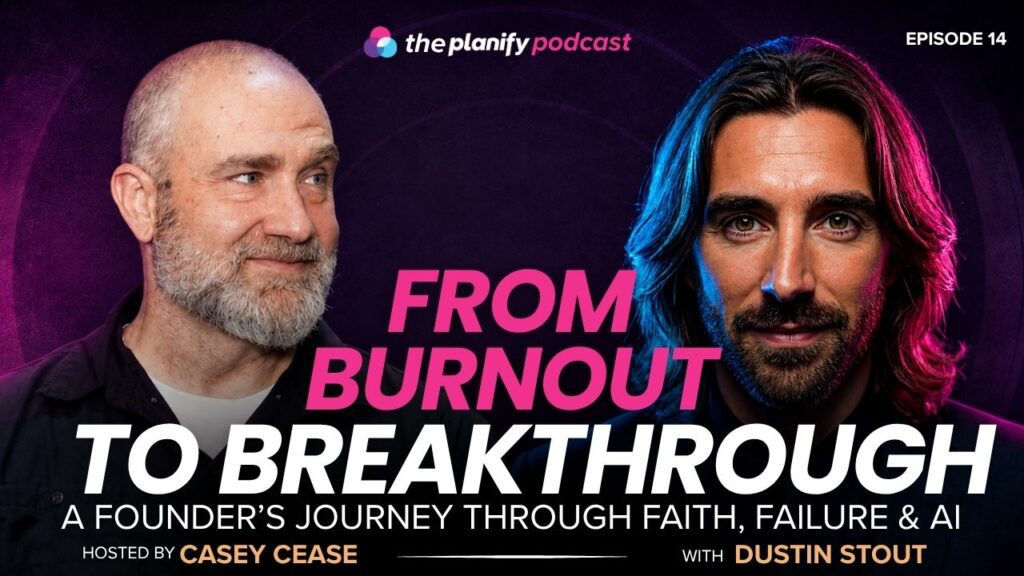
We are unpacking a conversation from The Planify Podcast between Casey Cease and Dustin Stout, founder of Magai, an all-in-one AI platform. Dustin’s path to building Magai did not start with a clean whiteboard and a clear plan. It started with two failed products, a wiped-out savings account, a wife’s terrifying health crisis, and a season so dark that Dustin openly shares he considered ending his life.
We are covering why so many business owners hit this exact wall, where people typically get stuck when trying to adopt AI tools or rebuild after failure, and a practical framework for moving forward, whether your struggle is emotional, financial, or simply “I don’t know which AI tool to use.
Why This Is Happening: The Real Root Causes Behind Founder Burnout
Business owners rarely burn out because of one bad month. It is usually a slow accumulation of unresolved pressure. In Dustin’s case, three things were happening simultaneously: a business partnership that had been quietly falling apart for years, a wife dealing with an undiagnosed health crisis compounded by a difficult benzodiazepine taper, and a public identity as “the face of the company” that meant every business problem became a personal attack.
This combination is common, even if the specifics differ. According to the American Society of Addiction Medicine’s clinical guideline on benzodiazepine tapering, discontinuing these medications carries real psychological risk, including depression and suicidal ideation, which is why tapering should always be done gradually and under supervision . Dustin describes his wife’s experience matching this exactly: a support group where several members died by suicide during withdrawal. That is not a minor detail. It is the kind of chronic, invisible stress that erodes a founder’s capacity to lead, long before the business itself visibly fails.
On the business side, the symptom was obvious: two products (So Visual and a webpage-to-social-content tool) that never found traction. The root cause was less obvious. Dustin describes having “a hundred million dollar vision” without the capital, team, or timing to execute it. This is a common founder trap: building for the vision you can see in five years instead of the version you can actually ship and validate today.
Layer in a global pandemic, a family of three kids to support, a spouse who could not work, and a hiring market that saw Dustin as “a flight risk” rather than an asset, and the picture becomes clear. Burnout is not a personal failing. It is what happens when multiple systems (financial, relational, physical, emotional) are under strain at the same time with no relief valve.
Where You’re Getting Stuck: Common Misconceptions That Keep Founders Isolated
If you recognize any of this in yourself, here is where most business owners get stuck, and why.
Misconception 1: Asking for help is a sign of weakness or failure. Dustin describes actively avoiding reaching out to friends, including Casey, because he did not want to “burden anybody.” This is one of the most common and most dangerous patterns among entrepreneurs. The instinct to isolate during a crisis is, as Dustin puts it, “the enemy” working against you, not a rational response to your situation.
Misconception 2: You have to hit rock bottom before you’re allowed to ask for help. Many founders wait until they are in true crisis to reach out, rather than building a support plan in advance. Casey’s advice on the episode is a simple, actionable fix for this: build your “worst case scenario plan” before you need it. Identify who you would call if things got dark, and put their names down now, not in the moment of crisis.
Misconception 3: AI tools are only for tech experts. This misconception keeps many business owners from adopting tools that could meaningfully lighten their workload. Dustin built Magai specifically to counter this belief, designing it for “the average business owner, the average admin assistant, the average plumber, teacher,” not developers or AI engineers.
Misconception 4: You need a separate subscription for every AI capability. Many business owners assume that using ChatGPT, Claude, and Gemini requires three separate logins, three separate histories, and three separate workflows. That fragmentation is a real cost in time and context, and it is one of the specific problems Magai was built to solve.
A Practical Framework: What to Do When You’re Stuck (Personally or With Your Tools)
Whether you are navigating a personal crisis, a business pivot, or simply trying to figure out how AI fits into your workflow, here is a grounded, step-by-step approach based directly on what Dustin and Casey discuss.
Step 1: Build your support list before you need it. Casey’s recommendation is specific: identify your “top 20” people, and even if you feel afraid of what they might say, write down who you would reach out to if things got dark. If it is not a person, it might be a resource like the 988 Suicide and Crisis Lifeline, which is available 24/7 by call, text, or chat. Having this list ready removes the decision-making burden during a moment when your judgment is most impaired.
Step 2: Anchor to something bigger than the current setback. For Dustin, that anchor was his faith, specifically Ephesians 2:10, which he and his wife returned to repeatedly during the hardest stretch: the belief that if he was still here, there was still a purpose ahead of him. You do not have to share his faith to apply the underlying principle. Find whatever grounding belief or long-term reason keeps you moving forward when the short-term evidence says quit.
Step 3: Get scrappy and build with what you have, not what you wish you had. Dustin’s original hundred-million-dollar vision failed in part because he tried to build too much before validating anything. His pivot to Magai worked because he started small: an eight-week sprint using a $400 no-code course, direct outreach to that course’s creator for extra guidance, and constant feedback loops with real early users. If you are stuck on a project, ask what the smallest testable version looks like, not the biggest version you can imagine.
Step 4: Consolidate before you expand. Once you have validated a direction, resist the urge to bolt on more tools and more subscriptions. Magai’s core value proposition, centralizing ChatGPT, Claude, Gemini, and dozens of connected apps into one workspace with one shared history, reflects a broader principle: fragmented tools create fragmented thinking. Before adding another app to your stack, ask whether it can live inside a system you already use.
Step 5: Protect your integrity with the people who backed you, even when you don’t have to. When Dustin’s earlier products failed, he was not legally obligated to bring his original investors, including Casey, into Magai. He did it anyway, and he rolled early customers of the failed products into Magai for free. This is not just a nice story. It is a practical trust-building move that pays off in referrals, goodwill, and long-term relationships, which matters more than most founders realize when they are focused only on short-term survival.
Implementation Tips and Real Examples
Here is how this plays out in practice.
Scenario: You are a solo consultant juggling five different AI subscriptions. Instead of continuing to pay for and switch between ChatGPT, Claude, Gemini, and separate image or document tools, evaluate whether a centralized platform like Magai, which supports connections to more than 130 third-party apps including Google Drive, Outlook, Notion, and ClickUp, could reduce your tool-switching time and keep your project context intact across models.
Scenario: You are a business owner in a hard season and feel like no one would understand. Rather than waiting for the feeling to pass, send one message today to one person on your list. Dustin’s own turning point did not come from a grand gesture. It came from his dad texting to say he was a few minutes away. Small, ordinary check-ins matter more than we tend to assume.
Scenario: You are worried AI will replace your role, like the journalist “Patty” that Dustin mentions from his talks at the Evangelical Press Association convention. Patty had 40 years in journalism and felt her career was ending because of AI. After sitting through a practical, non-technical walkthrough of how to actually use the tools, she realized she could use AI to work faster and better, not get replaced by it. The lesson: proximity to practical AI education, not theoretical fear, is what changes outcomes.
Common Mistakes and How to Avoid Them
Mistake 1: Waiting for a “perfect” product before shipping. Dustin’s earlier startups stalled partly because the vision outpaced the available resources. Avoid this by defining the smallest version of your idea that can get real feedback within weeks, not years.
Mistake 2: Treating your business identity as separate from your personal wellbeing. Dustin describes being “the face of the company,” which meant business setbacks felt like personal indictments. Build a support system and language that separates “the business had a hard quarter” from “I am a failure,” even when that distinction feels hard to believe in the moment.
Mistake 3: Assuming AI tools require technical expertise. Many capable business owners avoid AI tools because they assume a learning curve reserved for developers. Look for platforms explicitly built for non-technical users, and start with one specific task, like drafting an email or organizing notes, rather than trying to learn every feature at once.
Mistake 4: Forgetting the people who supported you once things improve. It is easy to move fast once revenue picks up and forget the early believers. Dustin’s decision to honor his original investors and customers, without being legally required to, is a mistake-avoidance strategy in itself: it protects your reputation and your relationships for the next season of growth.
Frequently Asked Questions
What is Magai and how is it different from using ChatGPT directly? Magai is an all-in-one AI platform that centralizes access to multiple leading AI models, including ChatGPT, Claude, and Gemini, in one workspace with a single conversation history, document editor, and connections to over 130 third-party apps.
Is Magai only for technical users or developers? No. Magai was built specifically for non-technical business owners, admin staff, teachers, and other professionals who want the benefits of AI without needing coding or technical AI knowledge.
How do I know if my business is heading toward founder burnout? Watch for the combination Dustin describes: chronic unresolved business stress, personal or family strain happening at the same time, and a growing tendency to isolate rather than ask for help. If two or more of these are present, it is worth proactively building a support plan.
What should I do if I am having thoughts of suicide or know someone who is? Reach out immediately to the 988 Suicide and Crisis Lifeline, available 24/7 by call, text, or chat, or contact a trusted person on your support list. Do not wait until the feeling becomes unbearable.
Can switching to an all-in-one AI tool actually save time? Yes, primarily by eliminating the need to re-explain context every time you switch between separate AI subscriptions. Consolidating conversation history and connected apps in one place reduces the friction of tool-switching.
Why did Dustin choose to honor his original investors when he was not required to? He describes integrity as the most valuable asset a person or business can hold, and treats early supporters as long-term relationships worth protecting, not just legal obligations to satisfy.
What is the first practical step if I want to start using AI in my business but feel overwhelmed? Start with one specific, recurring task, such as drafting emails or summarizing documents, inside a platform built for non-technical users, rather than trying to learn every AI capability at once.
Conclusion and Next Step
Dustin Stout’s story is not a straight line from idea to success. It is failed products, a family health crisis, a devastating job rejection delivered by Facebook message on his birthday, and a father’s unplanned visit that changed the outcome of that day. What eventually became Magai only exists because Dustin kept moving forward one small step at a time, reached toward the people around him instead of away from them, and built something specifically for people who do not consider themselves “AI people.”
If you are a business owner feeling stretched thin, whether by personal struggle, business setbacks, or simply too many disconnected tools, the next step does not have to be dramatic. Build your support list today. Pick one AI task to simplify this week. And remember that asking for help is not the exception to resilience. It is what resilience actually looks like.
Get Your Custom Business Growth Strategy Blueprint
Ready to bring more clarity and support into your own business journey? Get your custom Business Growth Strategy Blueprint from Planify and take the next step with a plan built around where your business actually is today.